

Dolomites Photography Workshop: Immersive Edition
AN 8-DAY IMMERSIVE PHOTOGRAPHY WORKSHOP IN THE HEART OF THE DOLOMITES
Learn to see, simplify and make stronger creative decisions in complex mountain landscapes, with close field mentorship and a maximum of six photographers.
Join the 2027 priority list to receive the new dates and booking details before the workshop opens publicly.

A note from Andrea
I’ve been photographing the Dolomites for more than 20 years. What keeps bringing me back is how differently a place can feel as the light and weather change. That’s one reason we spend two nights in the mountains on this workshop: we have time to be there, rather than arriving for one photograph and leaving.
We begin near Cortina, spend a night at Rifugio Locatelli and another at Rifugio Lagazuoi, then finish among the meadows and distant peaks of Alpe di Siusi. These places give us very different landscapes to experience and photograph.
I’ll help you look beyond the obvious view, decide what interests you about a scene, and make photographs that reflect your experience of being there. With six photographers at most, we can work through those decisions together in the field and return to your images later to see what you might try next.
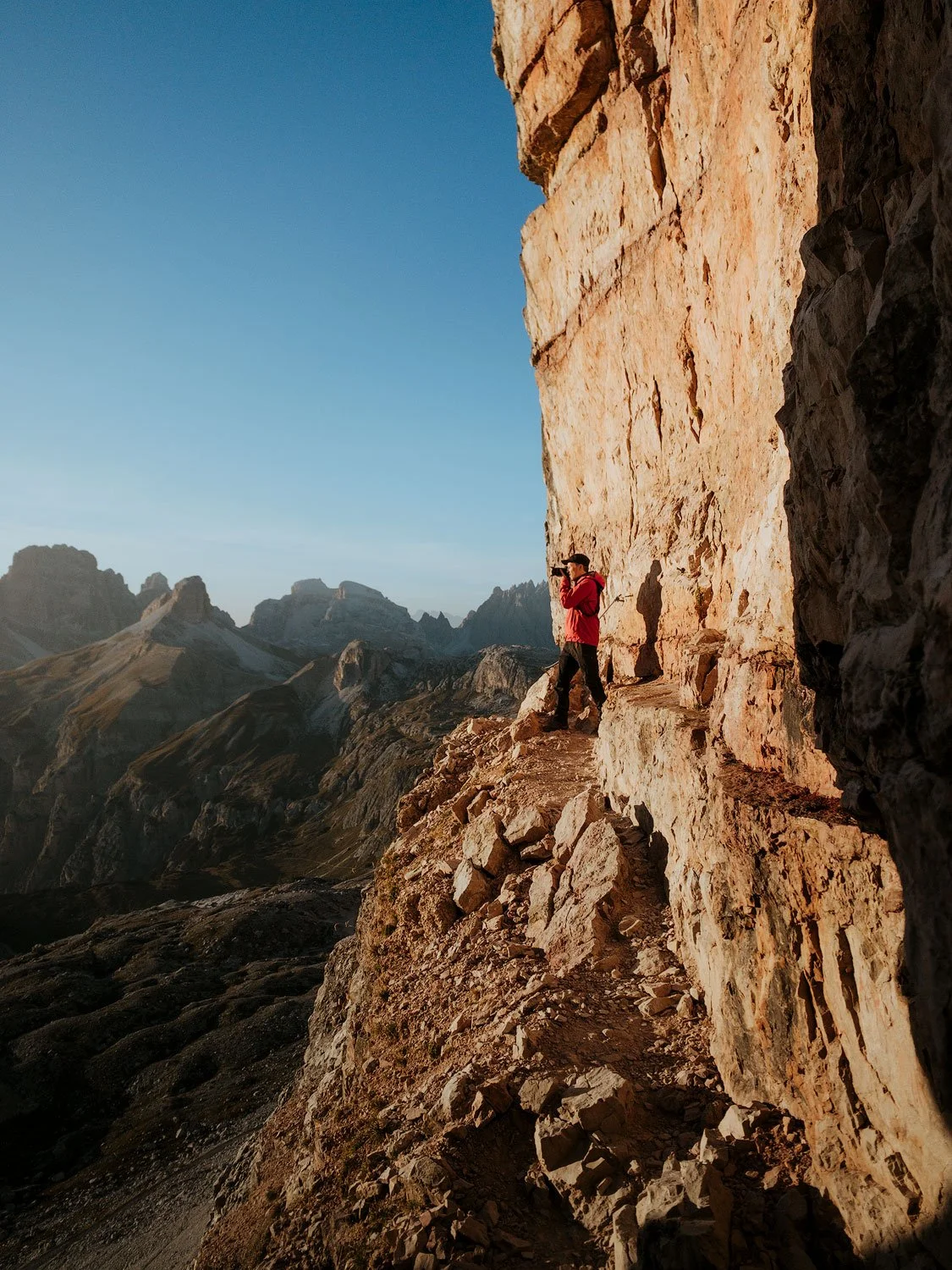
The Dolomites are spectacular from almost anywhere, but photographing mountain landscapes well is very different from simply standing in front of an impressive view.
The scale can be enormous. Mountain groups overlap. Light moves quickly across ridges and valleys. Clouds can hide one part of a scene while revealing something completely different somewhere else. A composition that looked promising ten minutes earlier may suddenly stop working.
That constantly changing environment is one of the reasons I find the mountains such a powerful place to learn photography.
Throughout the workshop, we’ll work on how to simplify complicated scenes, create relationships between foreground and distant peaks, use layers to communicate depth, recognize smaller compositions inside a much larger view and decide when a wide-angle lens genuinely helps—or when a longer focal length tells the story more effectively.
And because the group is limited to six photographers, we can work on those decisions together while you’re actually making them.
That’s an important part of the Immersive edition.
We begin with three nights near Cortina d’Ampezzo, giving us access to very different mountain environments across the Eastern Dolomites. From there, we move higher for two nights in the mountains themselves: Rifugio Locatelli, directly in front of Tre Cime di Lavaredo, and Rifugio Lagazuoi, almost 2,800 metres above the surrounding valleys.
Those nights give us something I value enormously in landscape photography: time to observe how a place changes rather than treating it as a viewpoint we visit for a single moment.
We then finish on Alpe di Siusi, where open meadows, forests, scattered huts, mist and distant mountain layers give us a completely different set of compositional possibilities.
“This workshop offers a great variety of locations and experiences, including some you may not be able to arrange by yourself. Everything ran so smoothly in the background that we could concentrate on photography.
There was always support in the field and in post-processing, with individual guidance based on what I needed. I learned a lot, and I was very happy with my decision to invest in these days. It was by far better than the cheaper location-scouting workshops I had booked in the past.”

WHAT’S INCLUDED
WORKSHOP INCLUDES
-
Personalized Field Mentorship → With a maximum of six photographers, you’ll receive close individual guidance in the field as we work on reading complex mountain landscapes, refining compositions and understanding the creative decisions behind stronger photographs.
Exclusive Mountain Access → We’ll spend five nights in carefully selected 4-star hotels, with private single rooms and bathrooms, combined with two nights in traditional high-altitude rifugi at Rifugio Locatelli and Rifugio Lagazuoi. In the rifugi, we stay in twin shared rooms reserved for our group, with shared bathrooms, as is typical in an alpine hut.
Seamless Logistics → Airport transfers, all local transportation, alpine taxis to hard-to-reach spots, and park entrance fees are covered.
Delicious Meals → All breakfasts and dinners, including authentic Italian cuisine in the rifugio and hotel.
Field-to-Edit Learning → We work on composition and light in the field, then return to the photographs we’ve made for focused group lessons, image reviews and editing. There is also time for individual feedback on your own images, so you can understand a decision, try an alternative and take that learning into the next session.
-
Travel costs to and from Italy
Lunches, beverages, and snacks
Alcoholic beverage (available but not included in the price)
Rifugio’s cable car ticket
Tourist tax of €2 day/person (to be paid in cash at check out)
Travel insurance with trip cancellation coverage and equipment insurance are strongly recommended.
Tips, extras, access to the hotel spa, and anything else not mentioned in “The Workshop Includes” section
PRACTICAL DETAILS
-
With a maximum of six photographers, I can spend time with you while you’re developing a photograph. We can look at what drew your attention, test a different framing or focal length, and talk through why one choice serves your idea better than another. I’m there to help you make those decisions with more confidence, not to hand you a tripod position to copy.
-
You don’t need to be an advanced photographer, but it helps to be reasonably familiar with your camera before arriving. Participants bring different levels of experience, so the guidance adapts: we might work on exposure and technical confidence, or spend more time on composition, changing light and how to give an image a clearer direction. Before the workshop, I’ll ask what you’d most like to work on so our time together has a useful starting point.
-
MODERATE
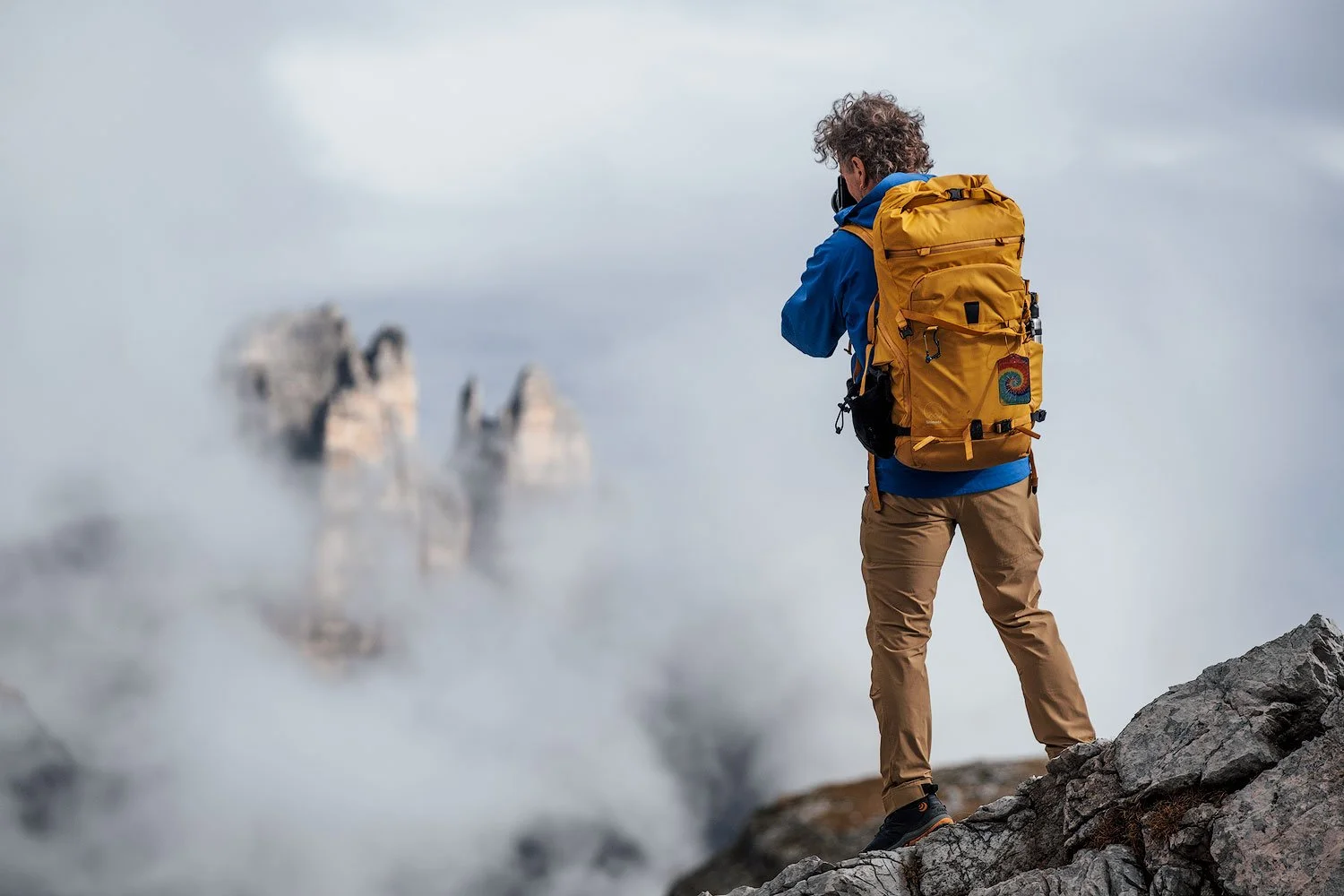
This workshop is suitable for anyone with a good level of fitness. We’ll hike at altitudes between 2,000 and 2,500 m, sometimes higher, on rocky and uneven terrain with some short but quite steep sections, so having a sure footing and balance is really important. The longest hike, such as the trail to Rifugio Locatelli at Tre Cime di Lavaredo, takes about 2 hours with roughly 200 m of elevation gain.
Still, you’ll want to pack light, as you’ll be carrying your camera gear and tripod for up to two hours at a time, and while none of the routes are technical, the altitude and cumulative effort of two hikes per day can make the experience physically demanding if you’re not prepared.
To maximize your photography time, the workshop is designed to minimize hiking where possible, using cable cars to reach rifugios and other locations. This ensures that most of your time is spent capturing the scenery rather than transferring or going on long hikes.
We always move at a comfortable pace, allowing plenty of time to enjoy the landscapes and photograph along the way.
If you’re used to flat terrain, have respiratory or mobility limitations, or are unsure whether your current fitness level suits this kind of activity, please contact us before booking so we can help determine if this workshop is the right fit for you.
-
The Dolomites are a mountain environment, and no particular light or weather condition can be guaranteed. We may encounter clear skies, cloud, rain, mist, wind, early snow or several of those conditions during the same workshop.
The same applies to autumn colour, reflections, dramatic sunrises, clear night skies and other conditions we would naturally love to photograph. They are possibilities, not promises.
The locations described in the itinerary give us a strong range of options rather than a checklist we have to complete. If weather, access or safety make another choice more appropriate, we adapt the plan and work with the strongest photographic opportunities available to us.
A TYPICAL DAY
-
On most days, we photograph in the morning, return to review images and discuss the decisions behind them, then head out again. You can try an idea in the field, see the result, get feedback and put what you’ve learned to use in a different landscape or light. The timing stays flexible around conditions and the needs of the group.
-
On most days, we start early and put ourselves in position before sunrise.
But we’re not simply waiting for the peaks to turn orange.
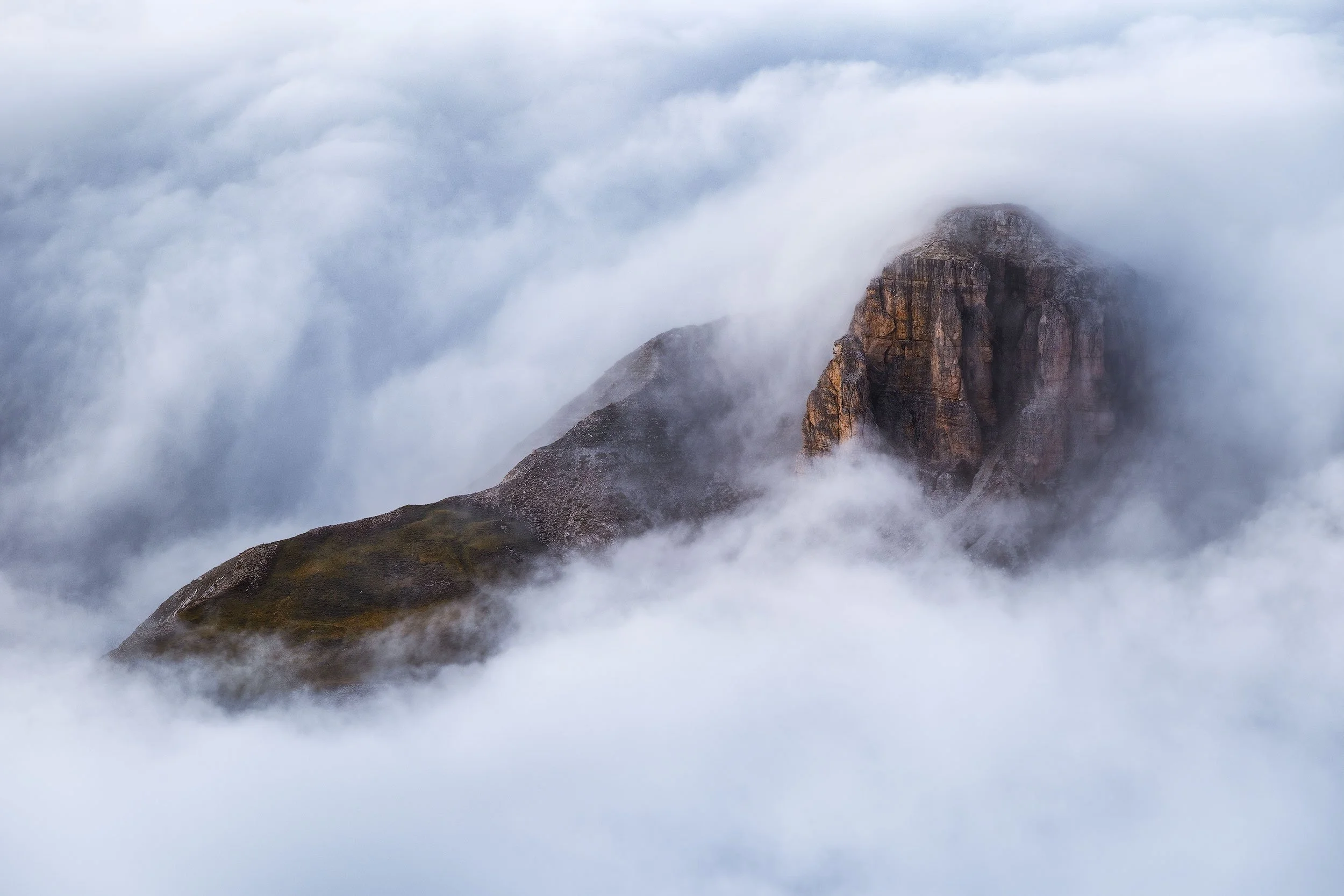
Morning conditions in the Dolomites can give us very different photographic opportunities: light catching individual mountain faces, mist separating layers in the valleys, strong silhouettes, reflected light, cloud moving through the peaks or quieter scenes before direct sunlight reaches them.
We’ll use whatever the landscape gives us to work on composition, focal-length choice and how to respond when the scene looks different from what we expected.
-
After our morning sessions, we make time to work on what we’ve been seeing and photographing. Some sessions are focused group lessons on composition and light; in others, we review photographs made during the workshop and discuss the decisions behind them. We look at what drew your attention, what could have been left out, and how the light affected the photograph.
We also work on editing, connecting choices made in the field with the final image. Depending on the group and the photographs we’re working with, we may use Lightroom or Capture One and Photoshop to explore RAW development, local adjustments and more advanced techniques when they genuinely help. Group processing sessions are recorded and shared with participants, so you can revisit them after the workshop.
Alongside the group sessions, I set aside time for individual feedback and editing help with your own photographs. That gives us room to work on the decisions you’re finding difficult, then take what you’ve learned back into the field. The timing remains flexible around weather and photographic opportunities.
-
The afternoon gives us the chance to take ideas discussed earlier in the day straight back into the field.
Sometimes that may mean refining something you struggled with in the morning. Other times the landscape gives us a completely different challenge.
As light begins moving across the mountains, we'll work on finding order in complex scenes, separating overlapping layers, using shadow and light to guide attention and deciding whether the strongest photograph is the grand view in front of us—or a much smaller detail hidden within it.
DOES THIS SOUND LIKE YOUR KIND OF WORKSHOP?
Join the priority list and you’ll be among the first to receive the 2027 dates and booking details when the next workshop opens.
WHERE WE’LL PHOTOGRAPH
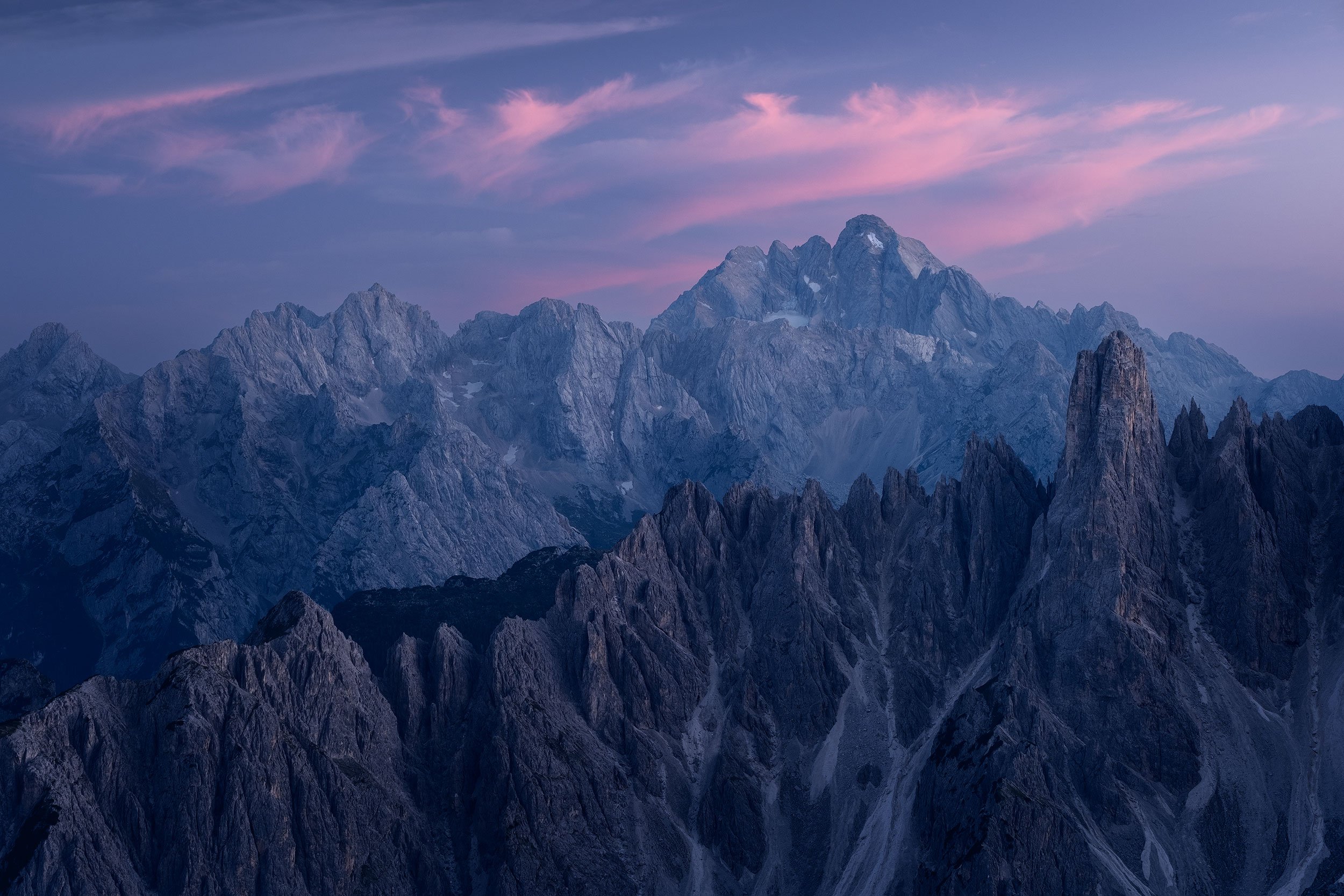
DAY 1 - 5 EASTERN DOLOMITES / CORTINA D’AMPEZZO AREA
The itinerary below shows the areas and photographic opportunities available to us during the workshop rather than a fixed shooting schedule. In the mountains, light and weather ultimately decide where we go, so we’ll adapt each session to the conditions and the strongest opportunities we see developing.

CORTINA D’AMPEZZO AREA | 3 NIGHTS
We’ll pick you up from Venice Marco Polo Airport and travel together to our first base next to the beautiful Lago Misurina, near Cortina d’Ampezzo, and after settling into our rooms, we’ll head out for our first sunset shoot on the first evening.
This is one of the most beautiful parts in all the Dolomites, with the jagged spires of the Tre Cime national park a short drive away, and the high passes of Passo Giau and Falzarego also close by.
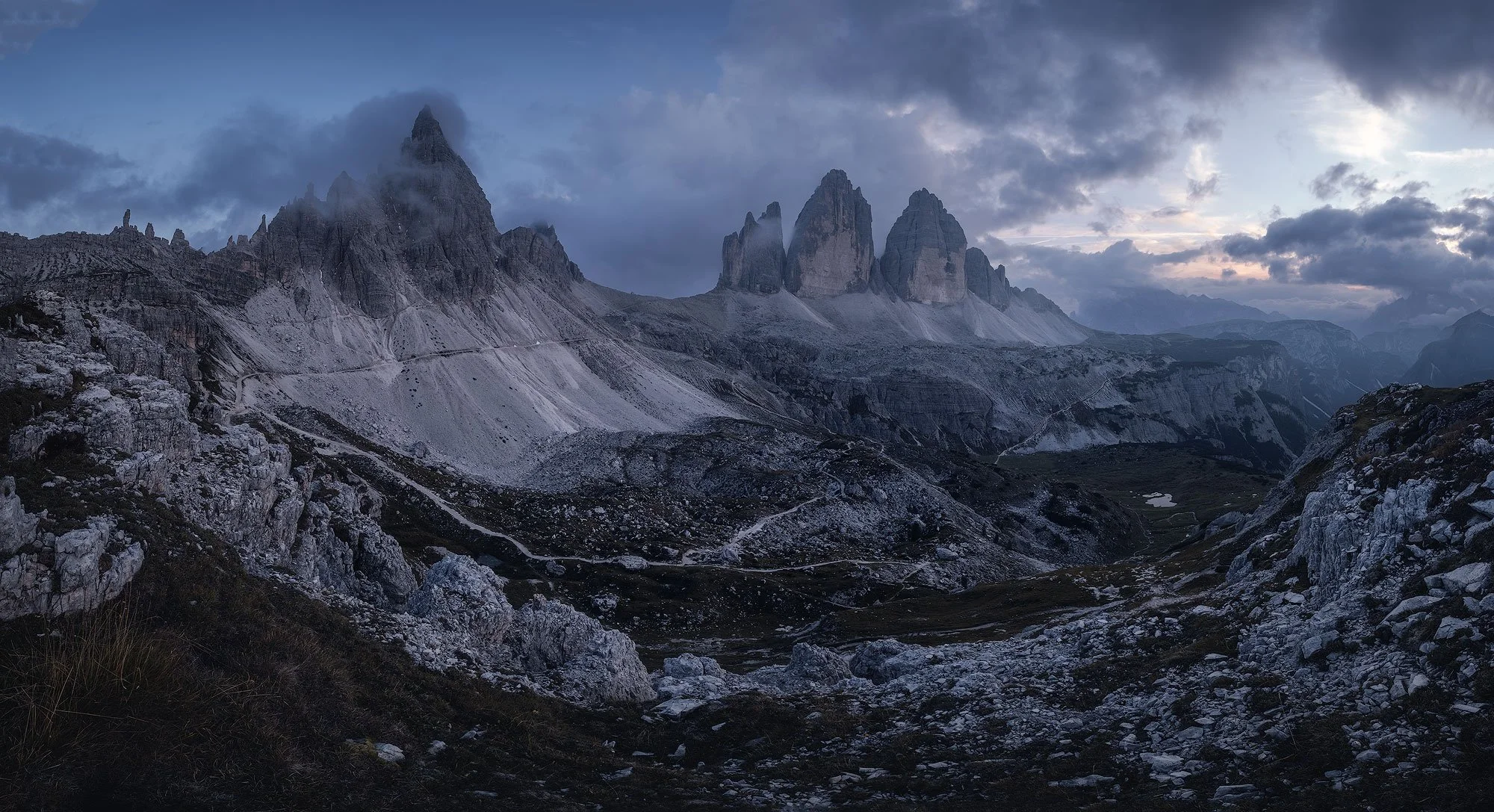
We’ll certainly be spending lots of time in the Tre Cime area, where we’ll hike around the famous three peaks to get to different points from where we can unlock the almost unlimited potential of this incredible place. There are the trails south of Rifugio Auronzo, which give uninterrupted views of the stunning peaks of Cadini di Misurina as well as views of the Tre Cime towers themselves, lit from the side as the sunsets.
We’ll also hike around the southern side of the peaks and up the saddle to the Forcella ridge, which gives the iconic view facing west towards the Tre Cime peaks with the setting sun behind.
A NIGHT AT TRE CIME | 1 NIGHT
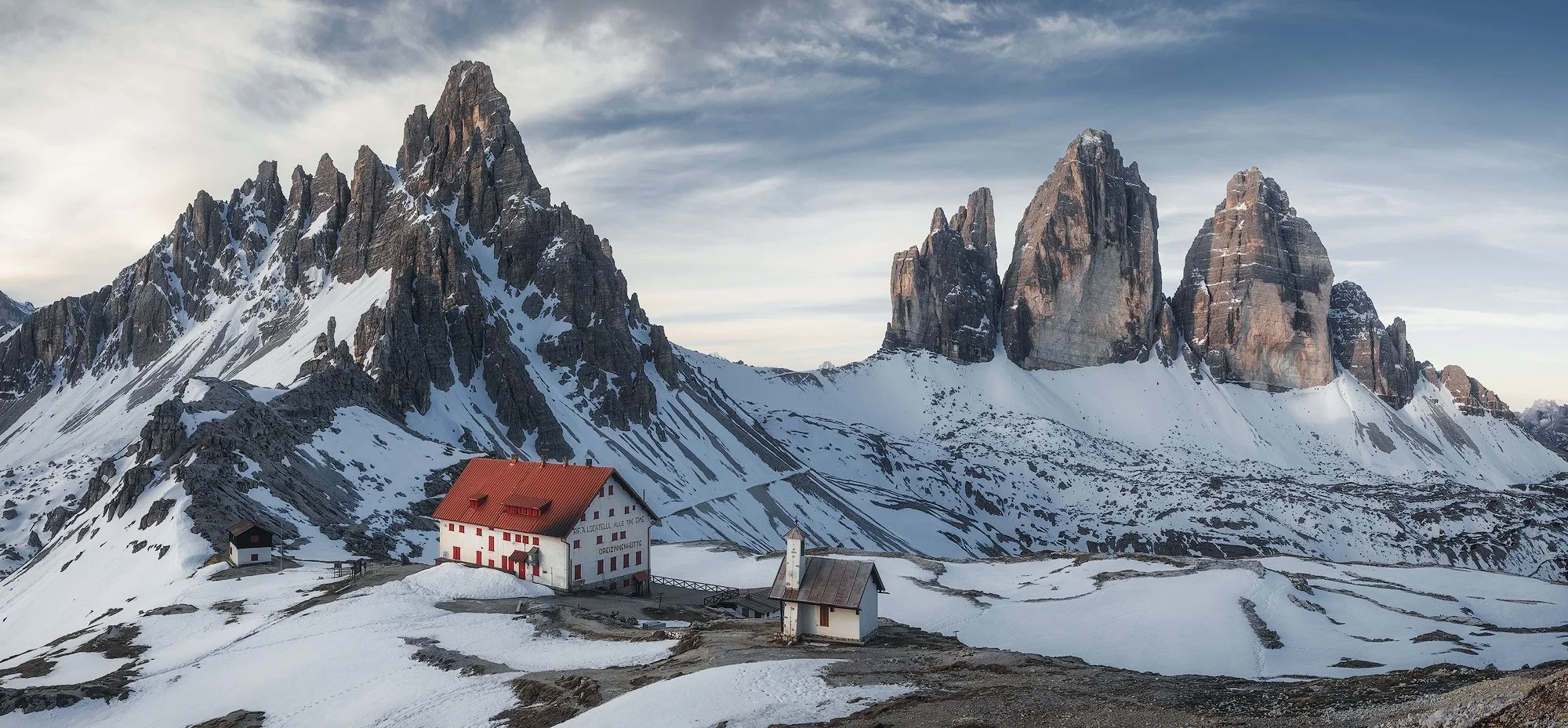
One of the highlights of the workshop is an overnight stay at Rifugio Locatelli, directly in front of Tre Cime di Lavaredo. Staying high in the mountains allows us to experience and photograph this landscape through some of its quietest hours, without having to return to the valley after sunset.
Depending on the conditions, we can photograph through evening light and blue hour, explore night photography, and wake up already in position for sunrise the following morning.
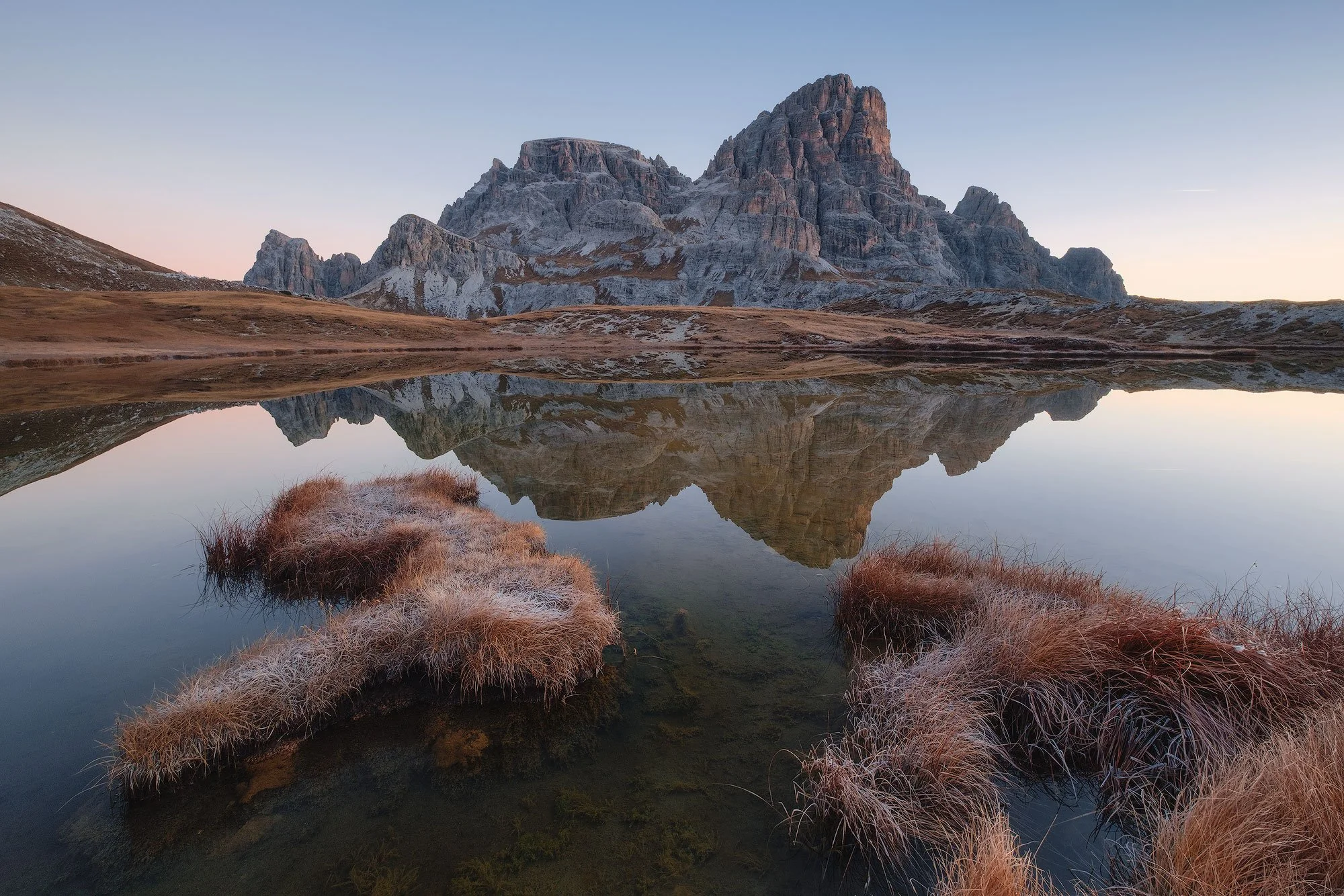
From the rifugio, we can also easily reach the nearby alpine lakes around Laghi dei Piani, where water, reflections, mountain layers and changing light give us a very different set of compositional possibilities. Reaching the same area from the valley for sunrise would normally mean a long hike in the dark and a very early start.
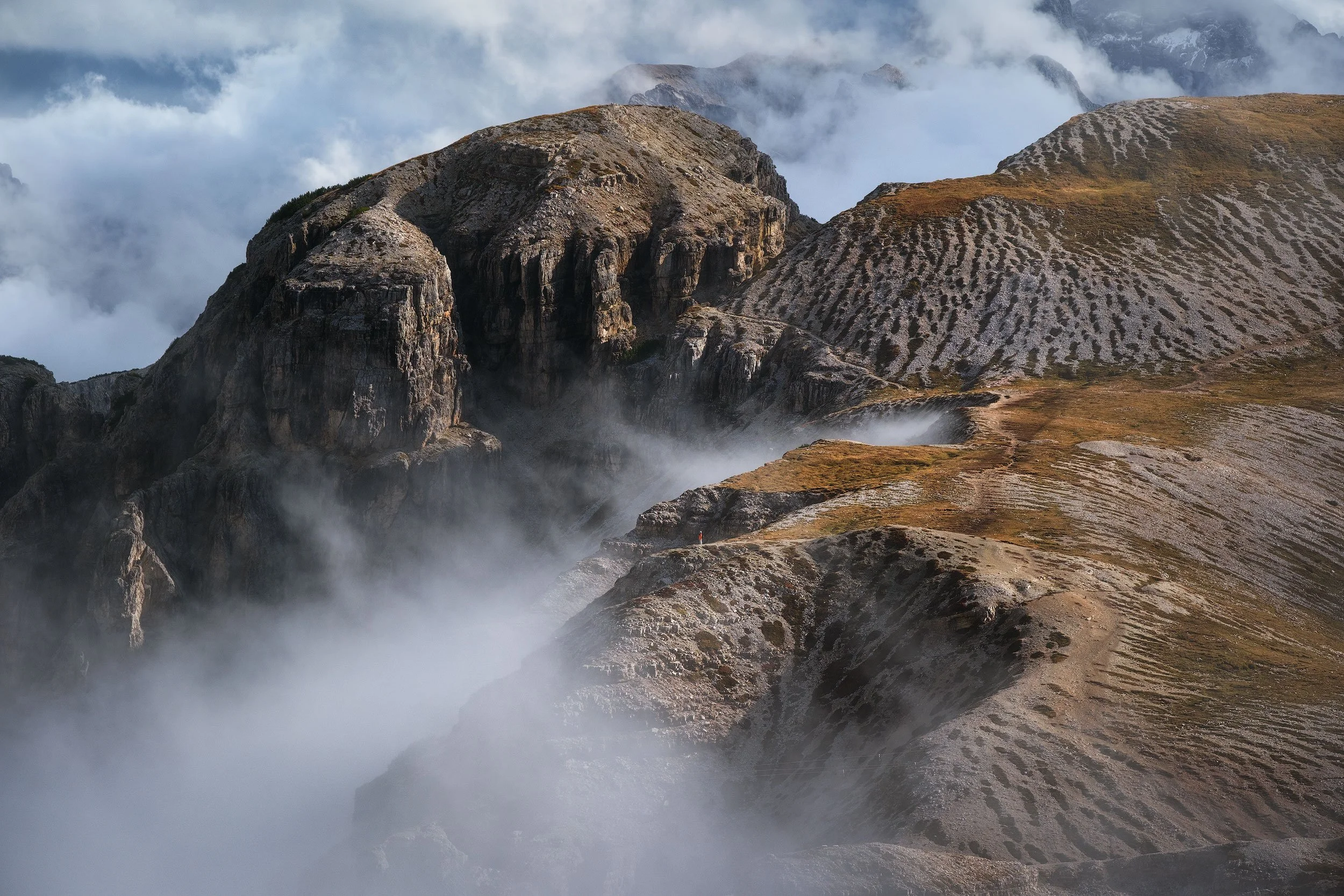
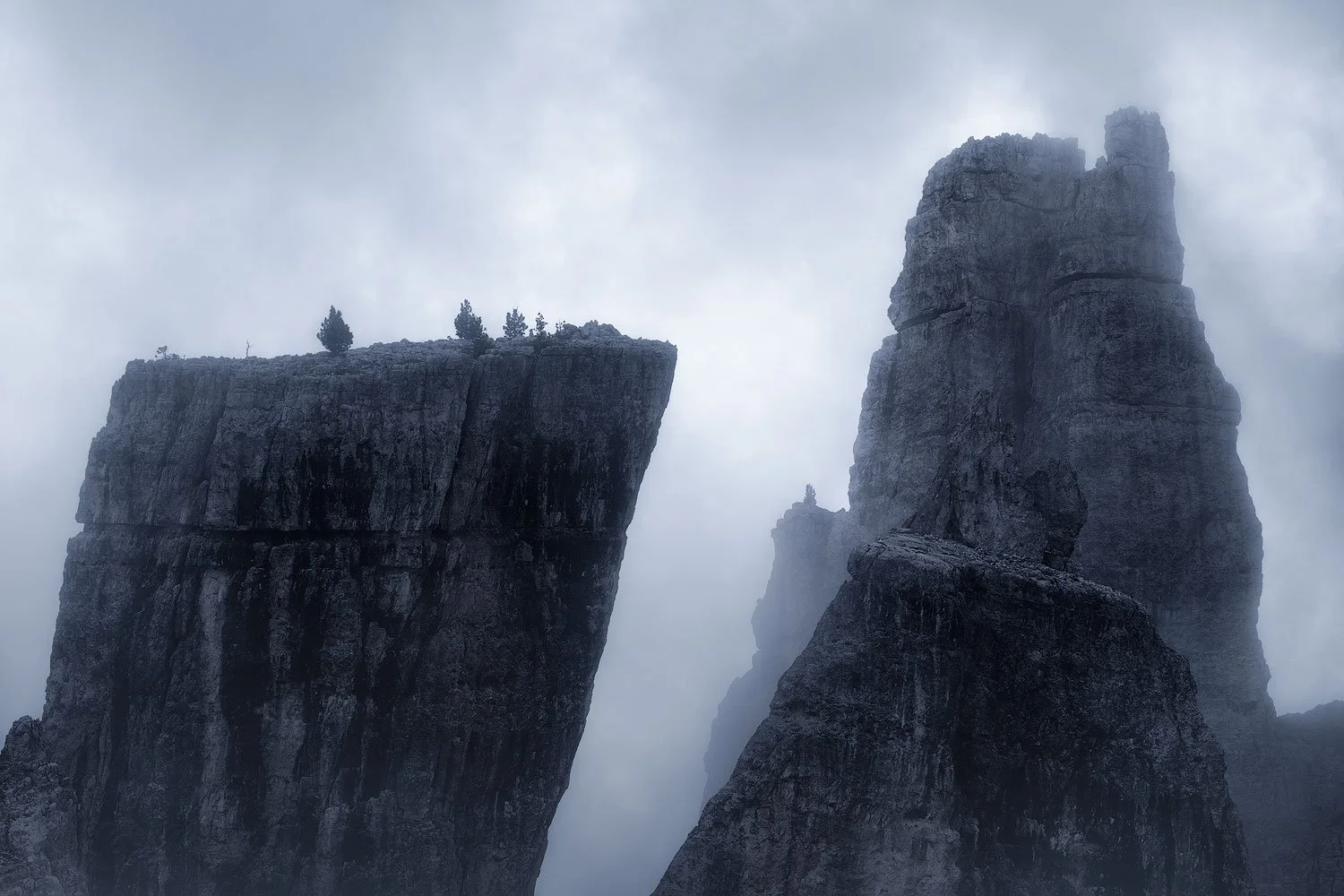


Other photographic options around Cortina include Passo Giau, Passo Falzarego and Lago di Braies, with the locations we choose depending on the conditions.
Giau gives us everything from expansive views around Ra Gusela to longer-lens compositions across the surrounding mountain groups. Around Falzarego, the short walk to Lago Limedes can offer a more intimate combination of water and mountain scenery, while Lago di Braies gives us opportunities to work with reflections, boats, repeating shapes and smaller details as well as the wider landscape.


4x4 Alpine Lake Experience
From our base near Cortina d’Ampezzo, Lago Federa is another photographic option we can reach using a local 4×4 alpine taxi.
The lake sits beneath Croda da Lago and is surrounded by forest, giving us a very different environment from the exposed high-mountain landscapes around Tre Cime. Here we can work with the relationship between water, trees and mountain forms, while the surrounding woodland also opens up possibilities for smaller and more intimate compositions.
Vehicle access allows us to reach the area efficiently and spend more of the morning photographing rather than using valuable shooting time on the approach.


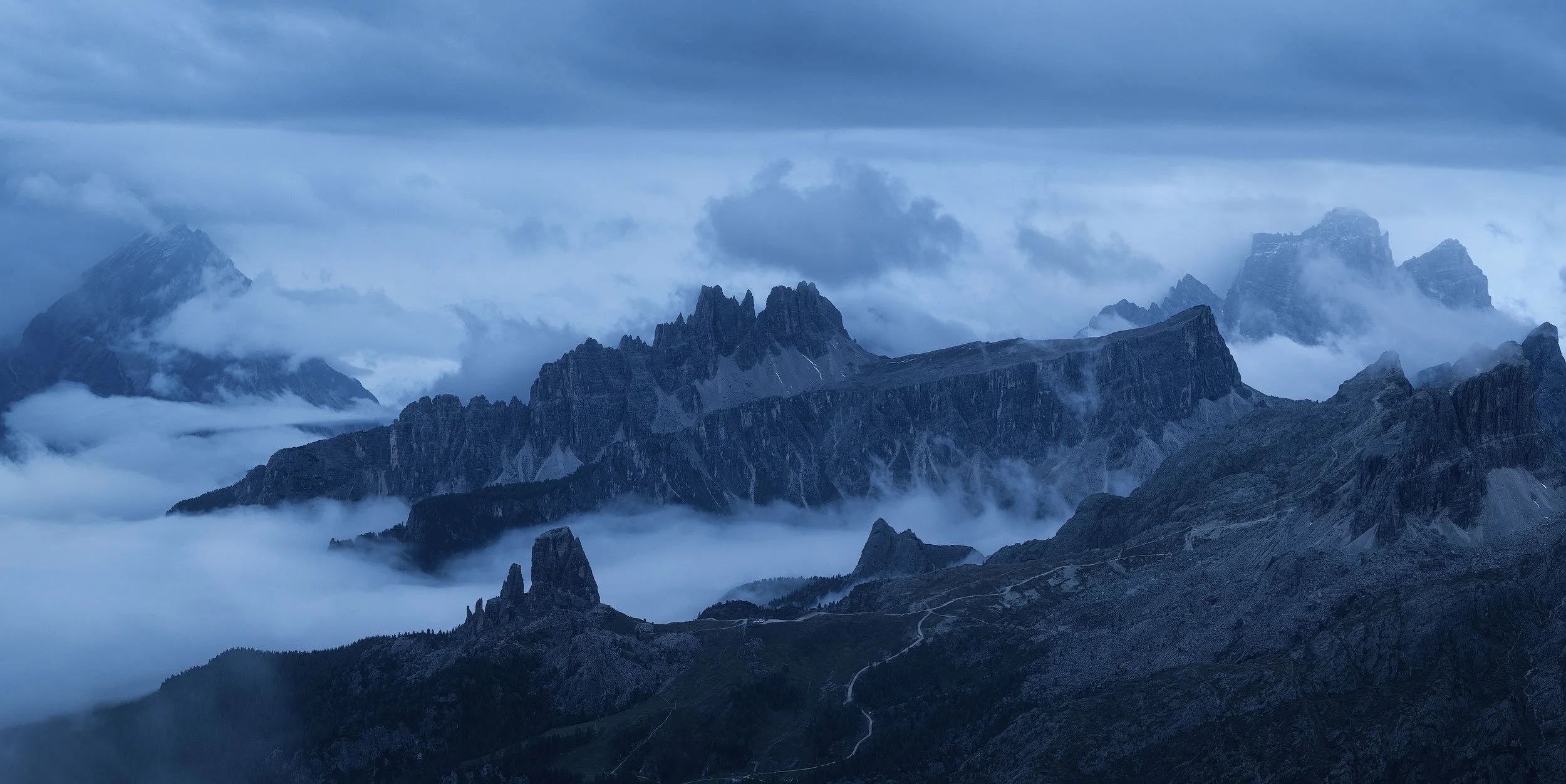
DAY 5 - 6 EASTERN DOLOMITES / CORTINA D’AMPEZZO AREA
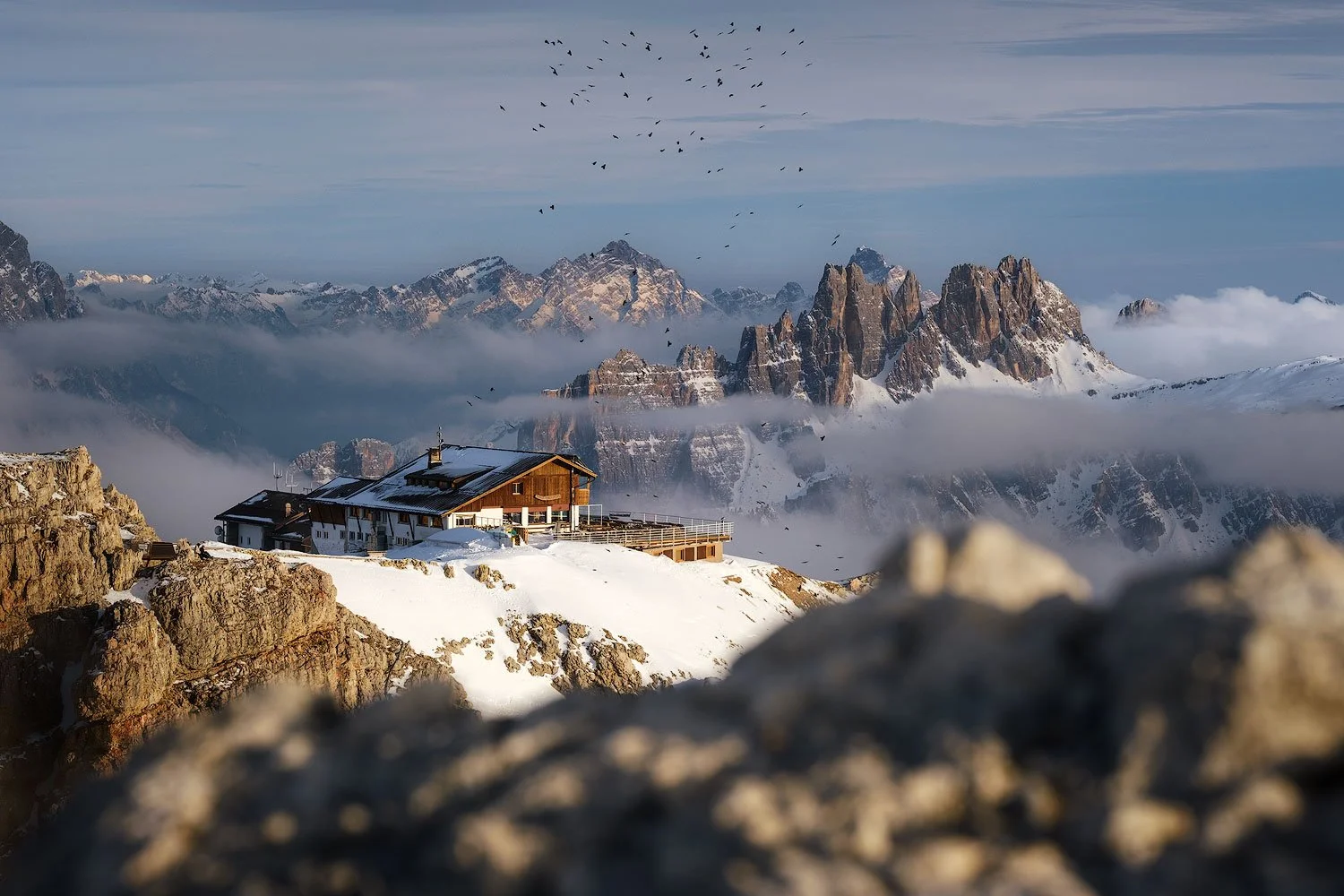
MOUNTAIN RIFUGIO | 1 NIGHT
After breakfast on Day 5, we’ll leave our hotel near Misurina and move to our second high-altitude base: Rifugio Lagazuoi, at 2,752 metres above Passo Falzarego.
We reach the rifugio by cable car, putting us high above the surrounding valleys without a long approach hike. From this elevation, the photographic possibilities change considerably. Instead of working beneath the mountains, we can look across multiple mountain groups and use distant peaks, overlapping ridges, cloud and atmosphere to create layers and separation within the frame.
The elevated position gives us access to an extraordinary range of directions and subjects, including Antelao, Tofane, Odle, Pelmo, Cinque Torri, Croda da Lago and Marmolada. Staying overnight means we can continue photographing as the conditions change through the evening and begin again from the same high position the following morning.
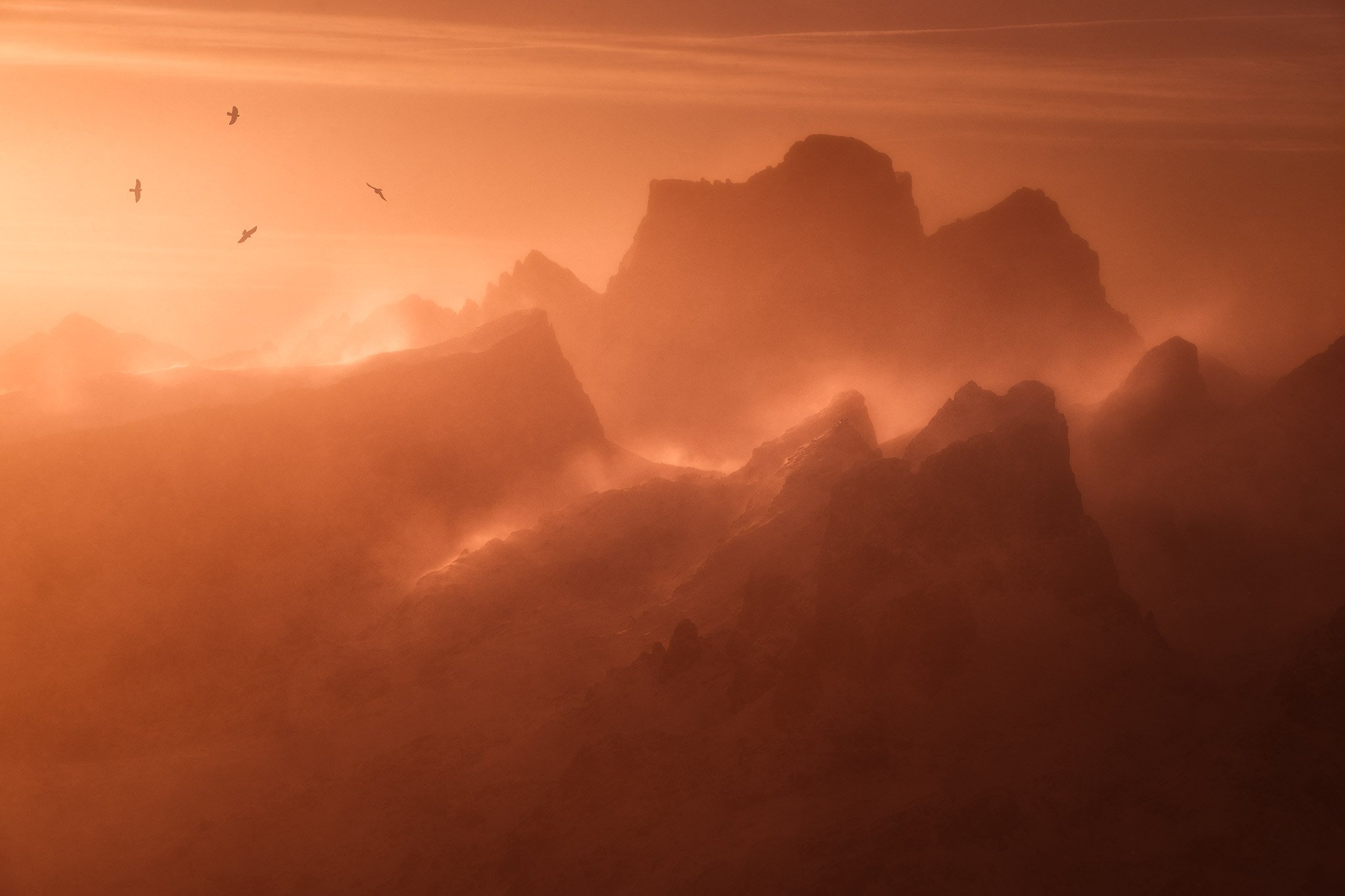
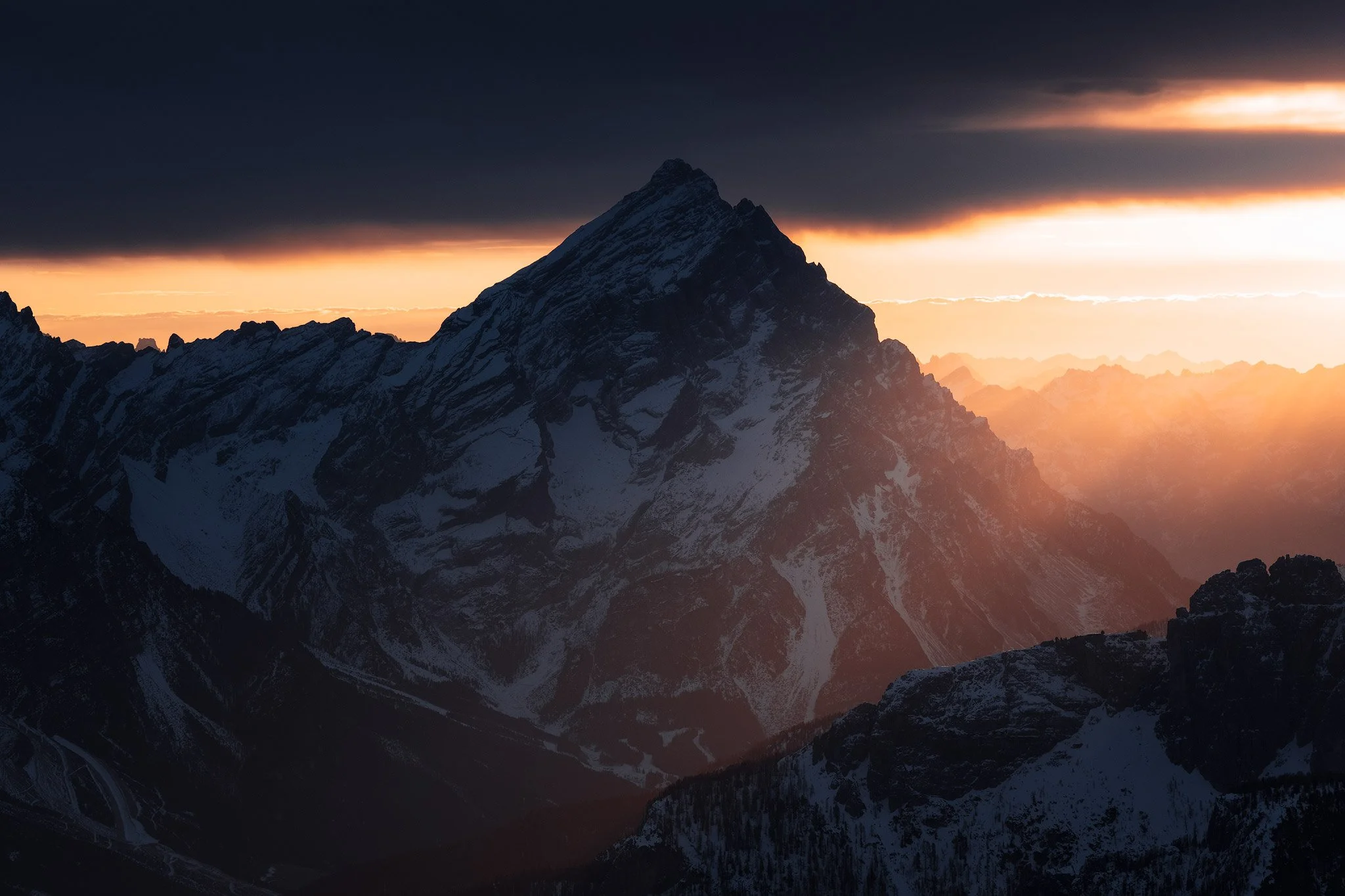

DAY 6 - 8 WESTERN DOLOMITES / ALPE DI SIUSI
ALPE DI SIUSI | 2 NIGHTS
After breakfast on Day 6, we’ll leave the Eastern Dolomites and travel west to our final base on Alpe di Siusi.
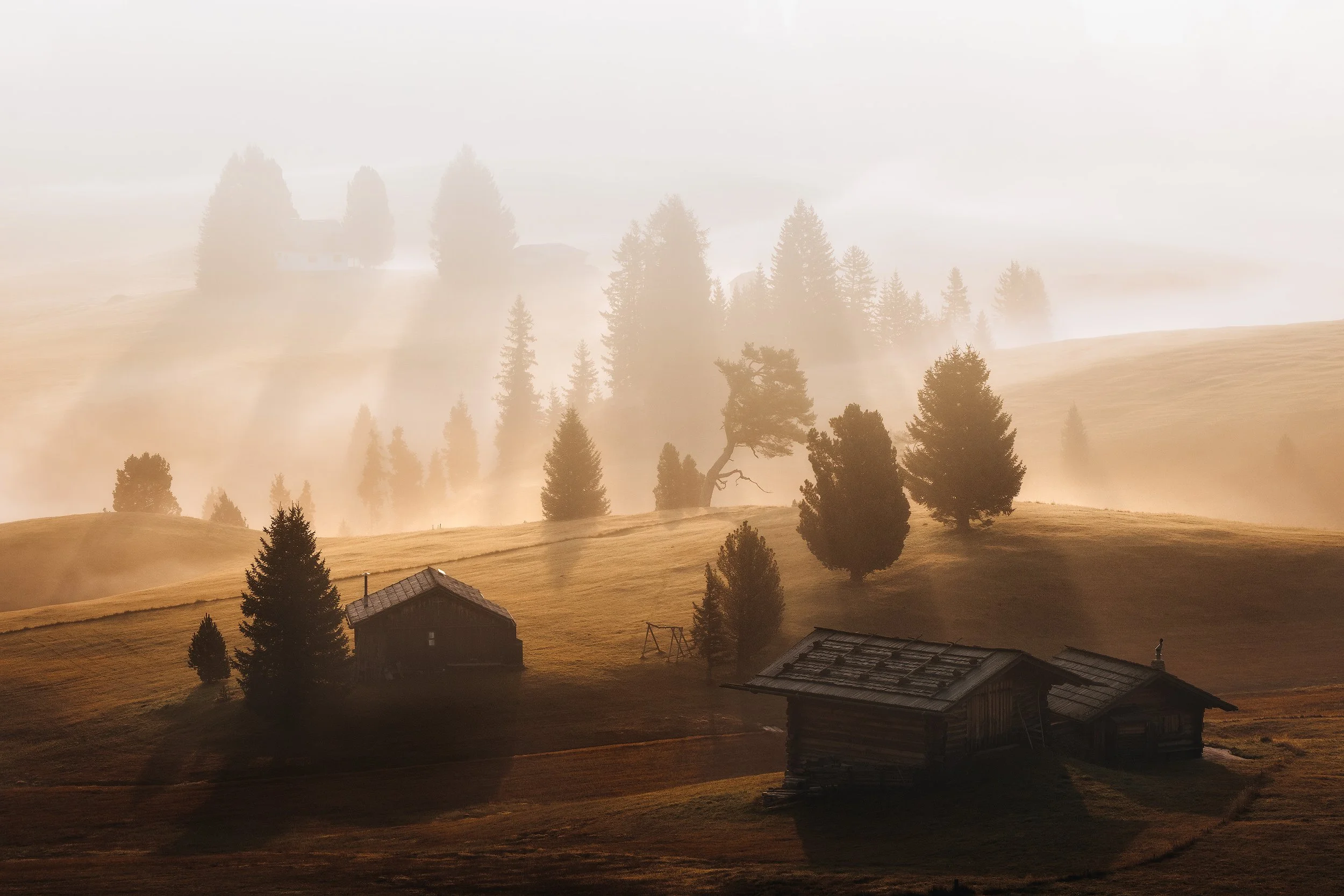
The landscape here is very different from the steep, rocky environments we photograph earlier in the workshop. Open meadows, scattered wooden huts, forests and the distant peaks of Sassolungo and Sassopiatto give us plenty of opportunities to work with layers, visual separation and longer focal lengths. If morning mist develops, the landscape can simplify even further into small groups of huts, trees and distant mountain forms.
The area works well in both morning and evening light, and staying directly on Alpe di Siusi gives us time to explore different compositions as the conditions change rather than approaching it as a single viewpoint.
We’ll stay in a 4-star hotel on the plateau, where we’ll also have time for another processing and image-review session using photographs made during the workshop.
On our final morning, we’ll have breakfast, check out and travel back to Venice, where we say our goodbyes.


WHAT THE PARTICIPANTS SAY…


WHAT WE’LL WORK ON TOGETHER
Mountain landscapes can give you almost too much to photograph.
One of the central goals of this workshop is therefore to help you move beyond simply recording what is in front of you and become more deliberate about what you want the photograph to communicate.
We’ll work on those decisions together in the field, then use our processing and review sessions to understand the results and put the ideas back into practice.
-
Finding a direction for the photograph
We’ll look for what matters in a scene, decide what to include or leave out, and consider whether the story is in the wide view or a smaller part of it.Working with depth, scale and focal length
Position, light, atmosphere and lens choice can change how mountain layers relate to one another. We’ll use them deliberately to give the photograph a clearer structure.Responding to light and weather
The conditions may change the photograph we thought we’d make. We’ll look for opportunities in cloud, mist, shadow and brief changes of light, rather than relying on one kind of sunrise.Making the technical choices the image needs
Depending on the scene, we may work on exposure, difficult contrast, panoramas or other field techniques. The technique should help you show what interested you about the place.Looking beyond the obvious subject
A forest, a distant ridge, a mountain hut or a small pattern of light can say as much about a place as its best-known viewpoint. We’ll leave room to notice those photographs too.Drone photography
Where regulations and conditions allow, we can also explore the very different compositional possibilities offered by photographing the mountain landscape from above. -
Post-processing is where we complete the decisions we began making in the field.
Rather than teaching techniques for their own sake, we'll use Lightroom or Capture One and Photoshop according to what each photograph actually needs.
That can include RAW development, local adjustments, Photoshop layers, luminosity masks, exposure blending, panorama stitching, sharpening and dodge and burn—but the objective is always the same:
to help the finished photograph communicate the light, depth, atmosphere and visual hierarchy that made you stop and photograph the scene in the first place.
-
With only six photographers, we spend a lot of time together—not only in the field, but during transfers, editing sessions and meals.
That naturally creates plenty of opportunities to exchange ideas, talk about photography and learn from the way other people approach the same landscape. At the same time, there’s no expectation that everyone has to be social all the time. These can be long days, and having some quiet time is equally important.
What I want to create is a relaxed and respectful group where people feel comfortable asking questions, sharing ideas, concentrating on their own photography and enjoying the experience in their own way.
HOW WE ADAPT TO THE CONDITIONS
The itinerary gives us a plan, but the weather and light determine what makes sense each day. Accommodation and the main logistics stay fixed, but shooting locations and timing can change when the conditions give us a better opportunity—or when safety requires it.
After more than 20 years photographing the Dolomites, I know how differently the same area can work depending on cloud, visibility, wind, snow, or the direction of the light. We use that experience to decide where it makes the most sense to be, rather than following the itinerary simply because it was written in advance.
Sometimes that means changing the order of locations, returning somewhere at a different time, or choosing a completely different area. The goal is not to tick places off a list, but to give us the best photographic opportunities from the conditions we actually have.
“Through all of that, Andrea and Sabrina were flexible, reassuring, and inspired complete confidence.”
WANT TO JOIN A FUTURE IMMERSIVE WORKSHOP?
Join the 2027 priority list to receive the new dates and booking details before the workshop opens publicly.
ACCOMMODATIONS & FOOD
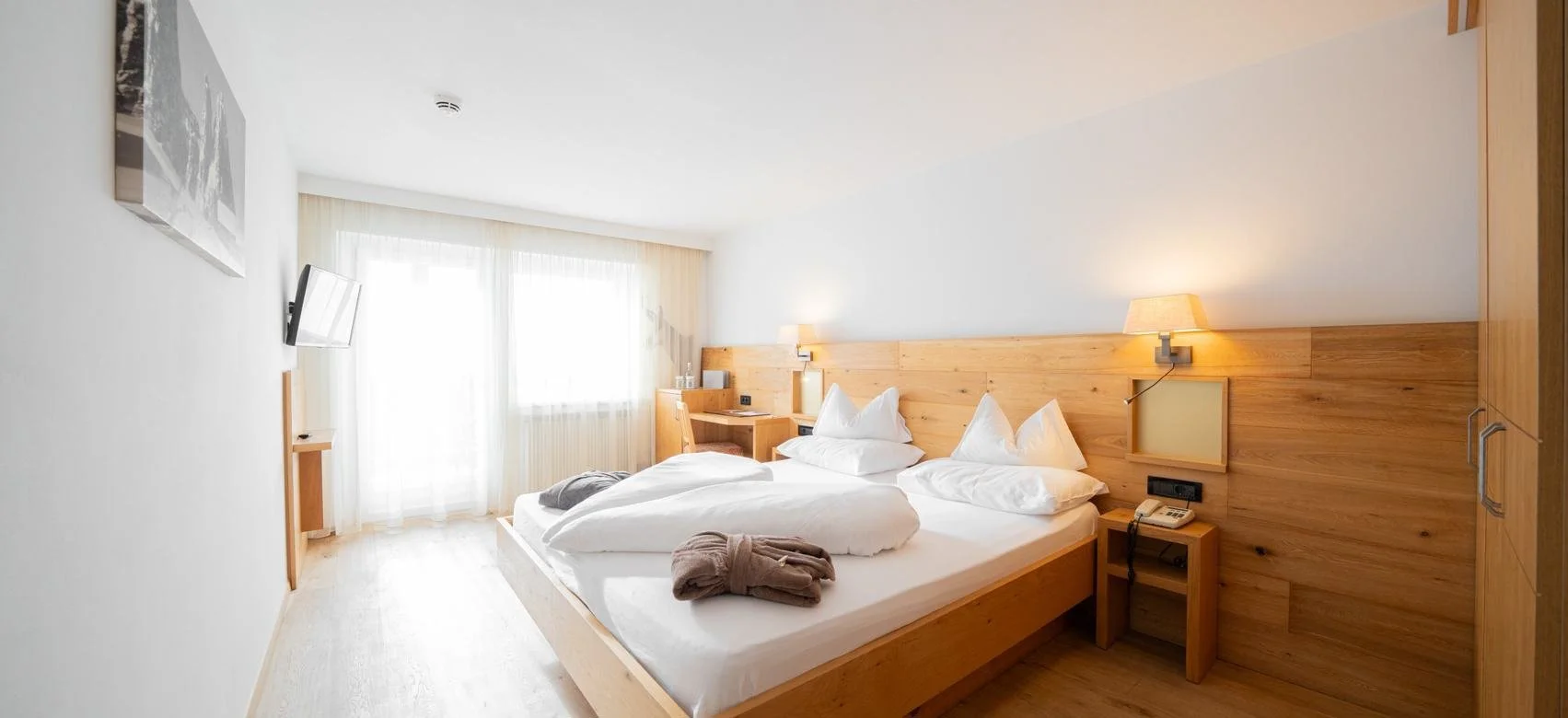
After a full day of exploring and shooting in the mountains, there's nothing better than coming back to a cozy place and enjoying a great meal. For our Dolomites workshop, we’ve handpicked charming, comfortable accommodations in ideal locations—places we know well and have built lasting relationships with over the years. And since we’re in Italy, food is a highlight in itself: you’ll get to experience some of the region’s best local dishes throughout the trip.
In the eastern Dolomites, we’ll stay in a 4-star hotel overlooking the beautiful Lago Misurina. For our main meals, we’ll head to a local pizzeria (one of the best in the Dolomites) where the owner, Angelo, and his family have become good friends over the many years we’ve been dining there. It’s the kind of warm, local connection that adds something special to the experience.

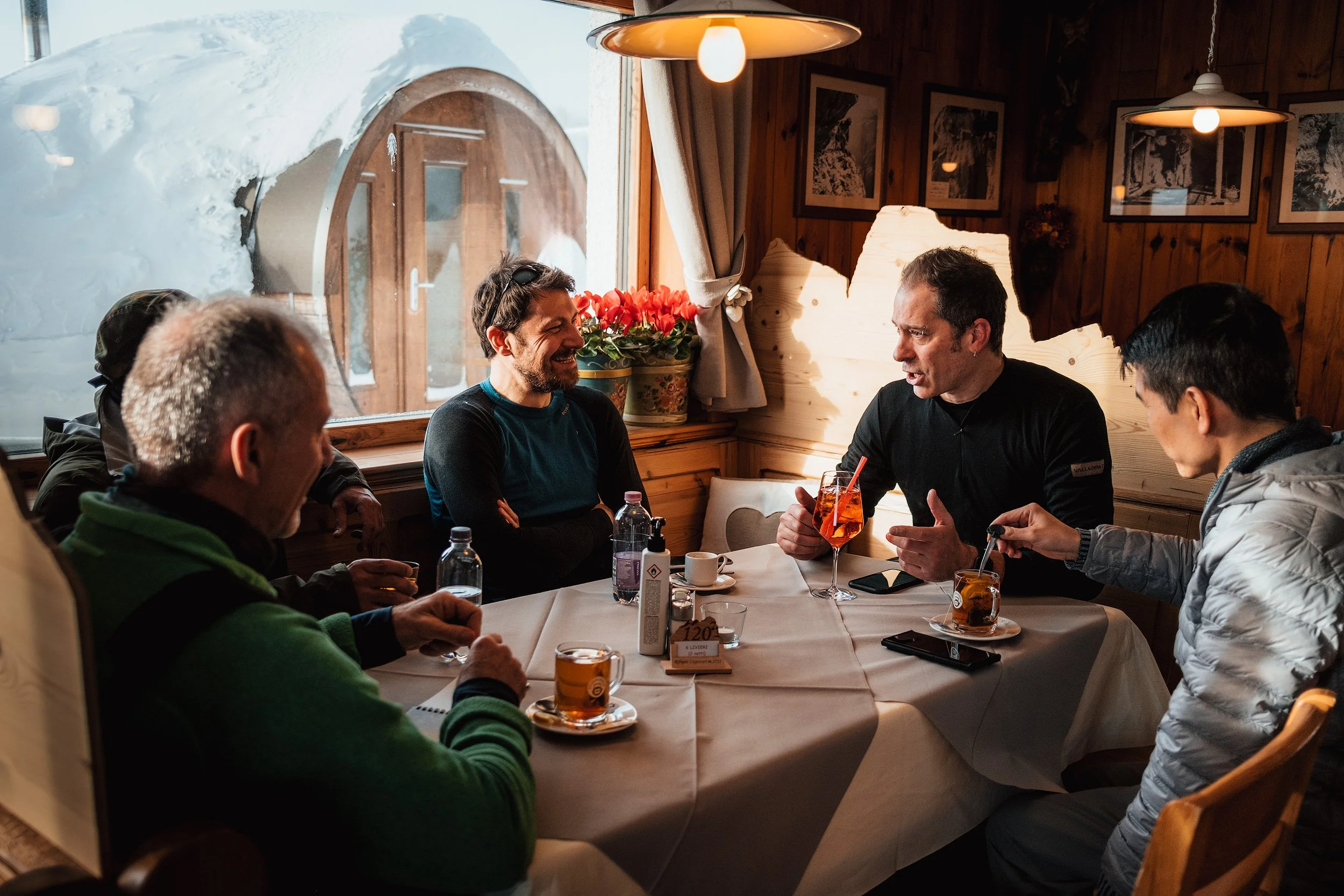
Two nights of the workshop are spent in traditional high-altitude rifugi, each offering a very different experience.
At Rifugio Locatelli, we stay directly in front of Tre Cime di Lavaredo, giving us exceptional access to the landscape from evening through sunrise. Later in the workshop, Rifugio Lagazuoi takes us to almost 2,800m, with expansive views across the surrounding Dolomites and easy access via cable car.
In both rifugi, we stay in twin shared rooms reserved exclusively for our group, with shared bathrooms, as is typical in an alpine hut. This means you’ll share your room with another workshop participant, but not with other guests — something that is relatively rare in such popular and sought-after mountain huts.
There’s an obvious trade-off in giving up your private hotel room for two nights. For this workshop, I think the photographic experience makes that trade-off worthwhile.
These stays are intentionally part of the photographic experience. They allow us to remain close to the mountains as the light changes, photographing through sunset and blue hour, exploring night photography when conditions allow, and waking up already in the landscape for sunrise.
The rifugi are also wonderful places to slow down after shooting, review images together and enjoy hearty local food surrounded by the mountains. The owners of both Rifugio Locatelli and Rifugio Lagazuoi are long-time friends, which makes these stays feel even more personal and familiar.
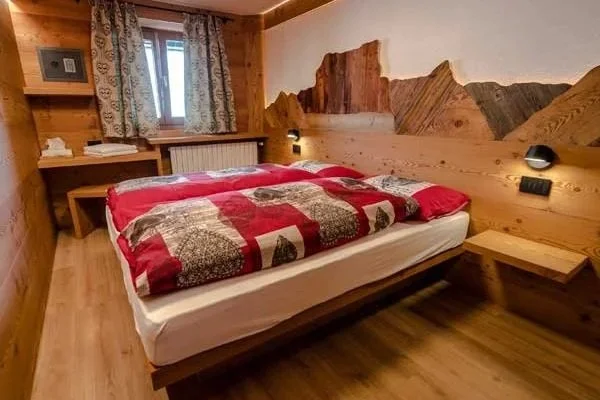
For the final two nights, we return to a 4-star hotel directly on Alpe di Siusi, with private single rooms and bathrooms. The food here is absolutely delicious, especially during their traditional Tyrolean-themed dinner night.
These partnerships allow us to offer not just comfort and convenience, but also a more authentic, memorable taste of the Italian Dolomites. Great photography days deserve great food—and here, you’ll have both.


HOW DO WE GET TO THE RIFUGIO?
One of the most common questions I get about the Immersive workshop is how much hiking is involved in reaching the two rifugi.
The two mountain huts are reached in very different ways. Rifugio Locatelli involves a scenic walk of around 1 hour 40 minutes, with relatively modest elevation gain and plenty of time to stop, photograph and enjoy the landscape along the way.
Rifugio Lagazuoi is completely different: we simply take the cable car up to almost 2,800 metres and step out directly into the high mountains.
Neither involves technical hiking or particularly demanding climbs. You need a reasonable basic level of fitness, especially because we’re moving at altitude, but this is a photography workshop rather than a hiking trip.


ADDITIONAL DETAILS
-
You will fly into Venice Marco Polo Airport (VCE), located just outside the city of Venice. On the first day of the workshop, we’ll pick you up directly at the airport and drive together to our first base in the heart of the Dolomites.
-
Travel insurance is not mandatory for travel to Italy, but we highly recommend it. So, consider it for unexpected medical emergencies, flight cancellations, or lost luggage.
-
During all five hotel nights, you’ll have your own private single room and bathroom.
The two rifugio nights are different. We stay in twin rooms reserved for our workshop group, so you’ll share with one other participant, and bathroom facilities are shared.
That is part of the traditional rifugio experience and one of the few compromises we make in order to stay directly in the mountains. Full accommodation details are provided before the workshop so you know exactly what to expect.
-
You can find all the details about cancellations in our Terms and Conditions. This includes deadlines, fees, and everything you need to know if your plans change.
-
We will send you a welcome document when you register. This document will have a full list of all the gear and accessories you should bring with you.
-
More details on the meeting point, gear, weather conditions, and more will be included in the welcome document we send upon registration. If you have any questions or anything you’re unsure about, don’t hesitate to contact us at info@andrealivieriphoto.com.
YOUR WORKSHOP LEADERS
-

ANDREA LIVIERI
Photographer and Workshop Leader
Andrea is a Padua-based, professional photographer, educator, musician, and spirited adventurer. He started exploring the photography medium by capturing images of fellow musicians, their families, and other friends and acquaintances in the music industry. As he continued honing his craft, he merged his love for photography and exploring the outdoors, amassing a body of photographic work featuring exhilarating landscapes and rugged mountain capes from around the globe.
He leads photography workshops focused on helping photographers understand their decisions, develop a more deliberate process, and strengthen their own way of seeing. His work has been published in Landscape Photography Magazine, Outdoor Photographer, Photo Plus Magazine, Digital Camera, Popular Photography and Fuji X Passion Magazine, among others. He also partners with brands like Capture One, DxO, FLM Tripods, Maven Filtes, Nya-Evo Camera Backpacks and Vallerret Gloves.
-

SABRINA TOSATO
Photographer, Operations and Content Manager
Sabrina is a photographer and travel writer based in Padua, Italy. Her average day is a mix of weird combinations and her greatest ambition is to make people dream, inspiring them through words and photographs. She manages a travel blog named The Tomato Soup where she offers advice on travel destinations and wild but high-end hospitality.
She has 10 years of experience in travel organization, focused on exclusive and tailor-made itineraries but eventually ended up as a digital marketing specialist. Passionate about the intersection of adventure travels, sustainability, and design, with inspiration and creativity at heart, she has a knack for capturing memorable moments of everyday life. Her work has been published via Afar Media, SuitCase Magazine, Inspired by Iceland, and Feel Slovenia.


READY TO PHOTOGRAPH THE DOLOMITES WITH US?
Join the 2027 priority list to receive the new dates and booking details before the workshop opens publicly.
Partners







Workshop attendees may receive access to special offers on selected photography products and software.