
Sigma 100–400mm for Fujifilm X Review: A Landscape Photographer's Field Test
Could a lens this long change the way I photographed a place I had already been exploring for eleven years?
That was the question I took into the Icelandic Highlands with the Sigma 100–400mm for Fujifilm X.
I recently published a detailed field review on YouTube: Sigma 100–400mm for Fuji X Field Test Video. It talks about the experience:
Why I wanted to move away from the familiar wide and aerial views of Iceland
How the lens helped me find smaller stories inside the landscape
How much reach you actually need for landscape photography beyond the novelty of a 600mm-equivalent view
The practical limitations of using a lens like this, especially when 100mm is the widest you can go
Whether the Sigma 100–400mm is a genuine alternative to Fujifilm’s 70–300mm and 100–400mm lenses
This article stays with the photographs a little longer, placing complete images beside 100% crops and explaining both what the files contain and why I chose to make them.
The story did not end in Iceland. A few days after returning home, I took the Sigma to Rotterdam for a photographic assignment commissioned by the city’s tourism office. A 100–400mm telephoto lens feels natural in the Icelandic Highlands. It is a far less obvious choice in a city that usually invites wide views of its skyline and architecture.
By the time I left Iceland, I thought I understood the lens: it was a way of extracting smaller compositions from a vast landscape. Rotterdam showed me that this was only half the story. It gave me a second way to judge the Sigma, not only by how closely it rendered detail, but by whether it could add something useful to a very different visual assignment.
If you have already watched the video, this article adds that second perspective. If you have not, everything you need is here.
A quick disclosure before we continue: Sigma Italia lent me the Sigma 100–400mm F5–6.3 DG DN OS Contemporary for these trips. They also lent me the Sigma 10–18mm F2.8 DC DN Contemporary used in Rotterdam. I returned both lenses afterwards. Sigma did not pay me to produce the video or this article and had no approval over what I photographed or what I say here. Some links in this article are affiliate links. If you purchase through them, I may earn a small commission at no additional cost to you.
Quick Verdict & Key Takeaways
A strong-value 400mm option for Fujifilm X
Is the Sigma 100–400mm a good lens for Fujifilm X?
Yes. In my field use, the Sigma 100–400mm F5–6.3 DG DN OS Contemporary delivered consistently strong sharpness throughout the zoom range, excellent five-stop optical stabilization and reliable autofocus for landscapes, architecture and slower-moving subjects.
For Fujifilm X photographers, it offers an interesting alternative to the Fujinon 100–400mm if lower weight and price matter more than native controls, more extensive weather sealing and having the tripod collar included.
Is the Sigma 100–400mm full frame?
The Sigma 100–400mm DG DN was designed for full-frame mirrorless cameras. The Fujifilm X-mount version is used on APS-C bodies, where its 100–400mm range provides approximately the same angle of view as a 150–600mm lens on full frame while weighing 240g less than the Fujinon XF100–400mm.
Pros: Consistently strong sharpness from 100mm to 400mm, excellent optical stabilization, manageable weight for its reach, common 67mm filter thread and solid construction.
Cons: No physical aperture ring, weather protection limited to the mount gasket, TS-111 tripod collar sold separately and no official Fujifilm teleconverter support.
Ideal for: Landscape and travel photographers who want 400mm, expect to work primarily handheld and value reach, portability and price more than native controls or extensive weather sealing.
Video: Sigma 100–400mm Fujifilm X field review in Iceland
The video follows my experience using the lens in Iceland; the article adds 100% crops, Rotterdam examples and more detailed comparisons.
Why I wanted 400mm in the Icelandic Highlands
Side-by-side comparison: Fujinon 50–140mm f/2.8 vs. Sigma 100–400mm on Fujifilm X bodies.
Before this trip, the longest lens I regularly used for landscapes was the Fujinon XF 50–140mm f/2.8. On a Fujifilm camera, it gives me a field of view equivalent to roughly 76–213mm, and it had always covered the range in which I felt most comfortable.
That comfort was part of the reason I wanted to try something else.
When you return to the same landscape over many years, familiarity helps enormously. I know the locations better, I can read the weather more confidently, and I can make better decisions for the photographers joining our workshops. Creatively, though, familiarity can also lead you back to the same solutions.
The light changes. The weather changes. Yet the photograph can remain surprisingly similar.
With the Sigma on a Fujifilm X APS-C body, 400mm gives an angle of view close to 600mm on full frame. I had used the Fujinon 100–400mm a couple of times to photograph surfers, but I had never worked at those focal lengths seriously for landscape photography. I was not sure whether 600mm equivalent would be useful or simply excessive.
Fujifilm X-T4 + Fujinon 100-400mm f/4.5-5.6 R LM OIS WR
These earlier photographs were made with the Fujinon 100–400mm on the Fujifilm X-T4 and first showed me what this focal range could add to my work.
What interested me was not only the extra reach. I wanted to stay at ground level and look more closely at the Highlands: small areas of light, distant figures, volcanic textures, overlapping slopes and brief relationships that can disappear inside a wider view.
Wide photographs and aerial views are still an important part of how I tell the story of Iceland. The long lens was not meant to replace them. It gave me another layer of that story.
Aerial shot captured with the DJI Mini 4 Pro
The most valuable change was not simply that distant subjects became larger. The lens changed the scale at which I paid attention. Instead of always asking how to organise an entire valley, I could ask which relationship inside it deserved the frame.
Sigma 100–400mm for Fujifilm X: specifications in brief
The full name is the Sigma 100–400mm F5–6.3 DG DN OS Contemporary. The version I used was made for Fujifilm X Mount.
These are the specifications that had a practical effect on my experience:
| Full name | Sigma 100–400mm F5–6.3 DG DN OS Contemporary |
|---|---|
| Lens mount | Fujifilm X Mount |
| Focal length | 100–400mm |
| 35mm-equivalent view | Approximately 150–600mm |
| Maximum aperture | F5 at 100mm to F6.3 at 400mm |
| Optical stabilization | Rated at 5 stops on Fujifilm X Mount |
| Weight | 1,135g |
| Dimensions | 86mm diameter × 199.5mm long at 100mm |
| Minimum focusing distance | 1.12m at 100mm; 1.60m at 400mm |
| Maximum magnification | 1:4.1 at 400mm, or approximately 0.24× |
| Filter size | 67mm |
| Diaphragm | 9 rounded blades |
| Tripod collar | Compatible with the Sigma TS-111, sold separately |
| Environmental protection | Rubber sealing at the lens mount |
The lens also has a focus limiter, zoom lock, two stabilization modes and an AF function control. You can zoom with the ring or use a push-pull movement on the front of the lens hood.
One point needs to be clear. Sigma describes the X-Mount version as having a rubber seal at the mount. This is not the same as the more extensive sealing found across Fujifilm’s WR lenses. The Sigma worked reliably in difficult Icelandic conditions, but one successful trip does not turn mount sealing into full weather sealing.
You can find the X-Mount-specific technical information on Sigma’s official launch page.
What the Sigma 100–400mm gave me in the Icelandic Highlands
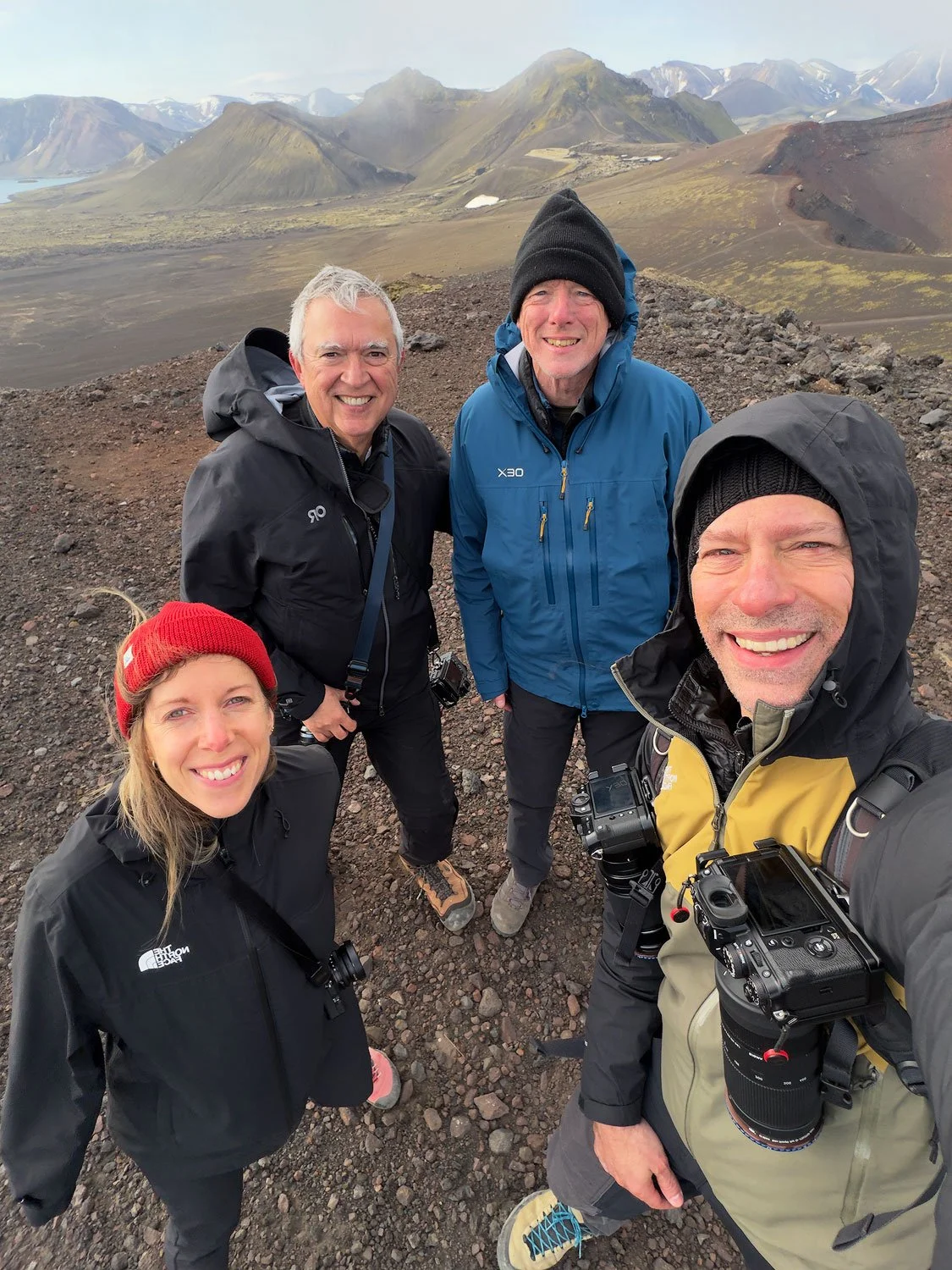
I was in the Highlands to lead an eight-day Iceland Highlands photography workshop with Sabrina and two other photographers. This was not a controlled lens test. I was working with our guests and reacting to conditions that could change quickly.
Over the eight days, we experienced almost every kind of light and weather the Highlands can offer. We moved from clearer, more directional light to heavy overcast, while also working through haze, strong wind and, in the south, a great deal of sand in the air.
Most days we photographed from around 9:00 in the morning until 19:00 or 20:00, following the conditions rather than building each day around a conventional sunrise and sunset session.
That variety gave me a much broader sense of what the lens could do. More defined light revealed contrast and fine texture, while flatter conditions encouraged me to look for quieter relationships within the landscape. When the wind, haze or sand arrived, the challenge was not only finding the composition, but bringing home enough stability and detail for the photograph to hold together.
At 100mm, I could simplify a scene while keeping enough context to describe the place. Between roughly 200 and 300mm, the frame became more selective. At 400mm, a figure, a line of light or a distant piece of terrain could become a photograph of its own.
I used the complete zoom range. That is important, because the value of a 100–400mm does not begin only when the lens reaches its longest setting. Often, the useful part was the ability to fine-tune the space between layers without changing my position or cropping heavily afterwards.
The video goes further into the individual experiences at Langisjór, Landmannalaugar and Mælifell. For the article, I want the images below to do something slightly different: show how the complete photograph and its fine detail hold up together.
You can read the broader story of our trip and location details in my Iceland Highlands Landscape Photography Field Report.
The longer focal length isolated the lone hiker against the layered rhyolite slopes, using the small figure to show the scale while simplifying the landscape into colour and shape. Landmannalaugar, Iceland - Fujifilm X‑T4 + Sigma 100-400mm // 231mm, f/8, 1/500 sec, ISO 320
The technical quality matters because I want the file to stand up to a large print or close inspection. But the detail is there to support the photograph; it is not the reason the photograph exists.
The longer focal length allowed me to isolate the transmission tower and bring the distant ridges, river channels and moss-covered foreground together in a single layered composition. Landmannalaugar, Iceland — Fujifilm X‑T4 + Sigma 100-400mm // 243mm, f/8, 1/500 sec, ISO 320
Even at 300%, the power lines remain clearly separated and the broader textures of the volcanic slope are still visible. The finest detail and local contrast have been softened by the long stretch of hazy, moving air between the camera and the subject—an effect made far more apparent at this degree of magnification.
Sigma 100-400mm Fuji Image Quality & Sharpness Test (100% Crops)
Landmannalaugar, Icelandic Highlands — Fujifilm X‑T4 + Sigma 100-400mm // 100mm, f/8, 1/400 sec, ISO 320 (handheld)
Looking at a file at 100% is not the problem. Treating that crop as a final verdict without considering how the photograph was made is.
A 100% crop is useful because it removes the flattering effect of reducing a photograph for the web. It makes fine detail, missed focus, movement, chromatic edges and sharpening much easier to see.
It can also encourage us to blame the lens for everything.
At these focal lengths, sharpness depends on the whole process: focusing accuracy, shutter speed, stabilization, wind, camera support and the amount of air between the camera and the subject. In Iceland, I was often working handheld across large distances while the wind was moving both me and the equipment. The atmosphere could soften detail before the light even reached the front of the lens.
Sigöldugljúfur canyon - Fujifilm X‑T4 + Sigma 100-400mm // 100mm, f/8, 1/50 sec, ISO 160 (captured with the camera on a sturdy tripod)
The Sigma did something more useful than look impressive in one or two isolated files: it remained predictable. Sharpness was impressively consistent throughout the entire zoom range, from 100mm to 400mm. I did not see a meaningful decline in fine detail at the long end, which meant that 400mm felt like a focal length I could use with confidence rather than a setting reserved only for occasional extra reach. For a working zoom, that consistency matters more to me than one exceptional result at a single focal length.
100% crop from the bottom-left corner, showing excellent sharpness and detail.
100% crop from the bottom-right corner - great detail
Across the frame, the corners were slightly softer than the centre but remained good throughout the focal range. Since this is a full-frame design used on an APS-C camera, the sensor records the central area of the image circle, where lens performance is generally strongest.
After correction, I saw little chromatic aberration. Distortion and vignetting were minimal, with Lightroom applying the built-in corrections automatically.
Chromatic Aberration - No Correction
Chromatic Aberration - Corrected
Fujinon XF50-140mm
Sigma 100-400mm
Color and contrast sat naturally beside the files from my Fujinon lenses.
These findings come from photographs made in the field rather than a complete series shot at every aperture and focal length. That is a limitation, but it is also the kind of information I can judge honestly from the work I actually made.
I will return to this later with two consecutive photographs from Rotterdam that made the influence of the atmosphere especially clear.
Note: All photographs were made in RAW and processed in Lightroom. The 100% crops come from the same finished files, with no additional sharpening applied specifically to the crop.
What a 100–400mm added to the Rotterdam assignment
I did not travel to Rotterdam simply to continue a lens test. I was there on a photographic assignment commissioned by the city’s tourism office, and my job was to tell a broader visual story of the city through architecture, details, atmosphere and moments of urban life. That distinction matters: the lens had to serve the assignment, not the other way around.
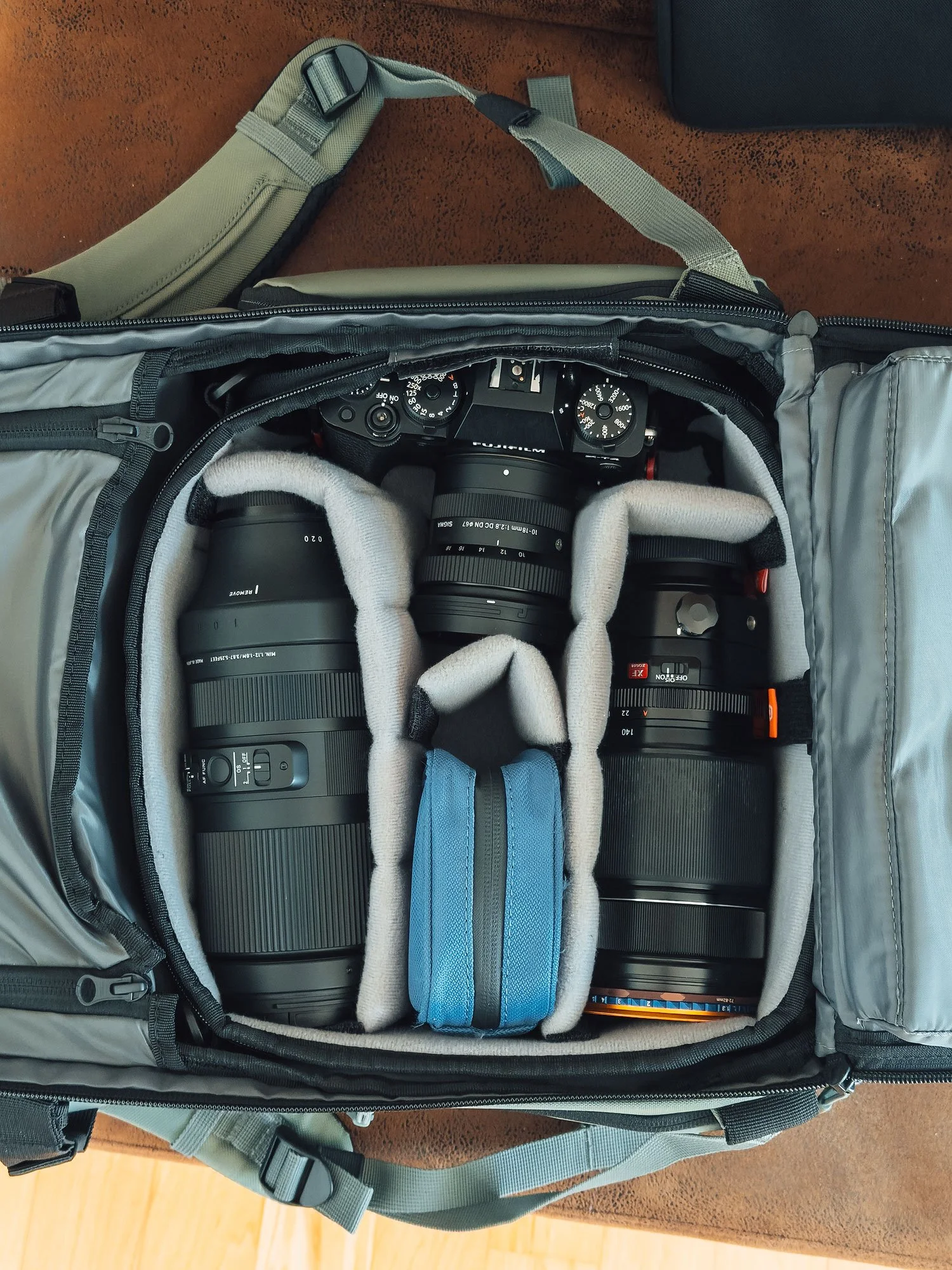
I brought three lenses: the Sigma 10–18mm F2.8, also lent to me by Sigma Italia; my Fujinon 50–140mm F2.8; and the Sigma 100–400mm. The 10–18mm gave me the broad architectural views. The 50–140mm covered the middle ground I already knew well. The 100–400mm added a much narrower perspective that I had rarely seen used to describe the city.
Rotterdam still needed the wide-angle photographs. What it did not need from me was only wide-angle photographs.
It was a deliberate experiment within the assignment. I was not trying to prove that a super-telephoto is all you need for city photography—it clearly is not. I wanted to find out what it could add when used alongside more conventional focal lengths.
Rotterdam Fenix Museum - Sigma 10-18mm F2.8 DC DN Contemporary
Rotterdam is naturally suited to wide-angle photography. Its skyline, bridges and ambitious buildings often invite you to show their complete form. I decided to move in the opposite direction with the Sigma and see how the city would look one section at a time.
This changed the pace of the work. Parts of the Iceland trip had been physically demanding, especially when wind and sand interrupted the process. Rotterdam was calmer. I could walk, observe and gradually settle into the focal range.
The restriction soon became enjoyable. I began noticing patterns across façades, small collisions between shapes, blocks of color and the way different materials met. Rather than explaining an entire building, I could dissect it. Instead of showing a whole area, I could isolate one small part that carried its character.
The 100–400mm did not replace the wider photographs the assignment required. It extended the story with images I would probably not have made with the other lenses.
By compressing the bridge cables against the apartment façades, the tight framing turns Rotterdam into a layered pattern of grids, diagonals, warm light and cool shadow—a city where architecture and infrastructure constantly overlap. Rotterdam — Fujifilm X‑T4 + Sigma 100-400mm // 400mm, f/6.3, 1/640 sec, ISO 320 (handheld)
At 100%, the balcony edges, railings and window frames remain clearly separated, while finer details in the curtains, furniture and vegetation show a slight loss of micro-contrast consistent with photographing through a long distance of warm urban air.
Architecture is useful for judging a lens because it is unforgiving. Repeated windows, fine structural details and straight edges make weak focus or lost resolution much easier to see. The stable conditions also made it easier to separate optical performance from the environment.
Fujifilm X‑T4 + Sigma 100-400mm // 340mm, f/8, 1/1000 sec, ISO 320 (handheld)
Fujifilm X‑T4 + Sigma 100-400mm // 400mm, f/8, 1/1000 sec, ISO 320 (handheld)
Fujifilm X‑T4 + Sigma 100-400mm // 400mm, f/8, 1/3200 sec, ISO 320 (handheld)
Fujifilm X‑T4 + Sigma 100-400mm // 400mm, f/6.3, 1/500 sec, ISO 320 (handheld)
100% Crop — Excellent detail
Fujifilm X‑T4 + Sigma 100-400mm // 400mm, f/6.3, 1/500 sec, ISO 320 (handheld)
Fujifilm X‑T4 + Sigma 100-400mm // 212mm, f/6.3, 1/1250 sec, ISO 320 (handheld)
Fujifilm X‑T4 + Sigma 100-400mm // 400mm, f/8, 1/800 sec, ISO 320 (handheld)
Sigma 100-400mm // 155mm, f/8, 1/640 sec, ISO 320 (handheld)
Sigma 100-400mm // 155mm, f/8, 1/640 sec, ISO 320 (handheld)
Sigma 100-400mm // 135mm, f/8, 1/400 sec, ISO 320 (handheld)
Sigma 100-400mm // 112mm, f/8, 1/800 sec, ISO 320 (handheld)
I used the whole zoom range and pushed it to 400mm several times, sometimes simply because I was curious to see how far I could take the idea. I was still working with a clear brief, but I allowed the restriction to suggest less obvious pictures within it.
That balance was the most satisfying part of the experience. The purpose of the assignment remained clear, but the lens opened another way of interpreting the city.
100mm focal length
400mm focal length
Left: 400mm at 100% crop — Right: 100mm enlarged to 400%
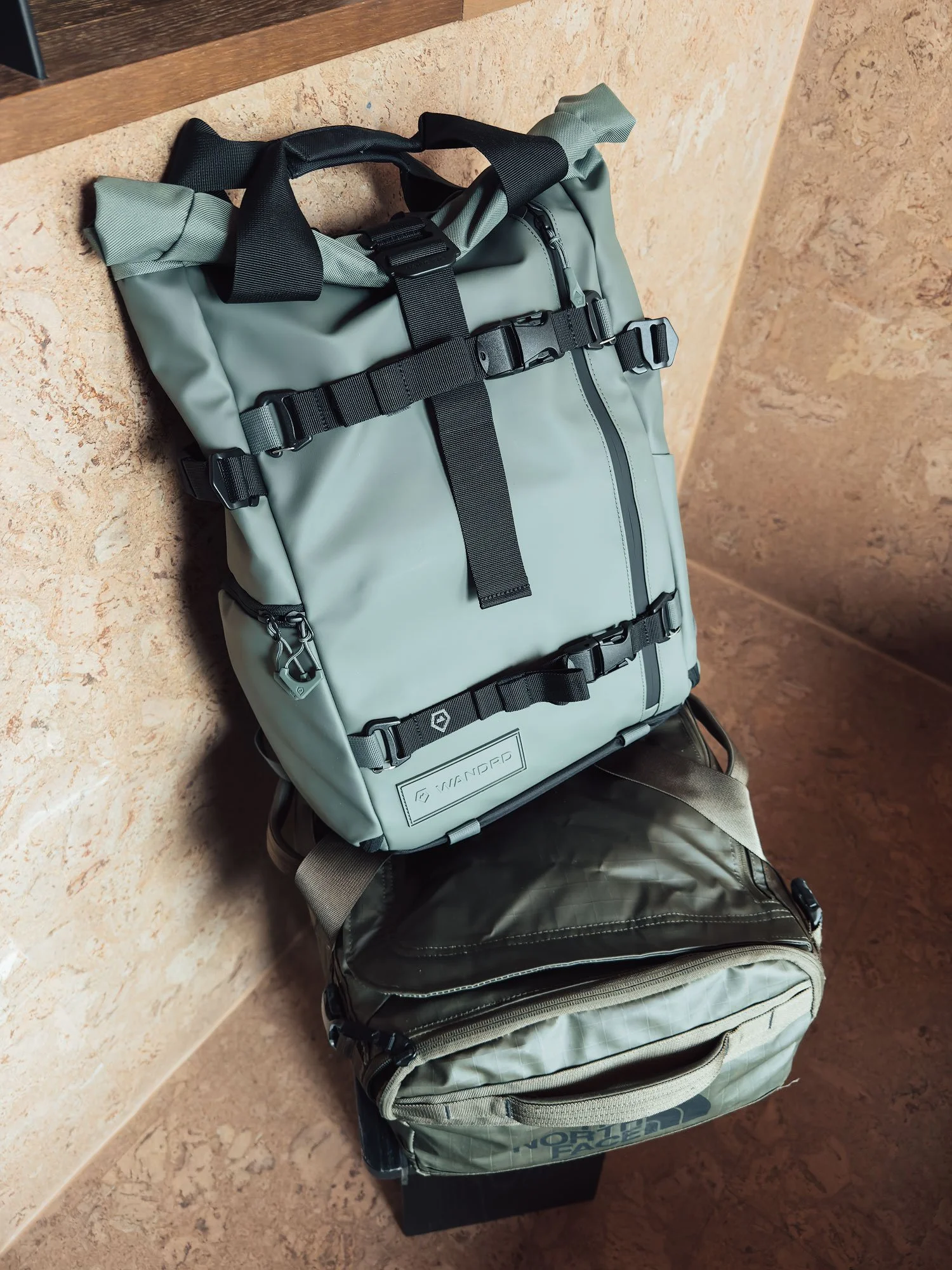
For some physical context, the Sigma 100–400mm and Fujinon 50–140mm together filled most of my WANDRD PRVKE 21L camera bag. It was a workable setup for walking around the city with one camera body, but there was not much unused space left.
When 100mm was still too long
Fujifilm X‑T4 + Sigma 100-400mm // 100mm, f/8, 1/1250 sec, ISO 320 (handheld)
The creative restriction did not always make the work easier. A limitation is useful only while it produces better decisions; at the Euromast, 100mm stopped being creatively productive and became a practical problem.
From the top of the Euromast, I wanted to make a panoramic view of Rotterdam. Even at 100mm, the Sigma was too tight for the field of view I had in mind. A lens beginning at 50mm or 70mm would have made the photograph much simpler.
44 vertical images captured at 100mm
I turned the camera vertically and photographed the view in two rows, leaving enough overlap between the frames to stitch them later. Doing this handheld was a little tricky because I had to keep both rows consistent while covering the entire scene.
It was not the most convenient solution, but it worked, and I came home with the panorama I wanted.
This is an honest example of the 100–400mm range. Starting at 100mm can encourage you to work differently, but there will be situations where it is simply too tight. In this case, I found a way around it. In another situation, I might not have had enough time or freedom to do so.
EUROMAST PANORAMA — FINAL STITCHED IMAGE
Total of 44 vertical frames, 35768×10476px for 465mp stitched in Lightroom.
View from the Euromast, Rotterdam — two-row handheld panorama made at 100mm. Fujifilm X‑T4 + Sigma 100-400mm // 100mm, f/8, 1/1600 sec, ISO 320 (handheld)
100% crop
100% crop
Handheld from a Moving Water Taxi: Stabilization in Real Use
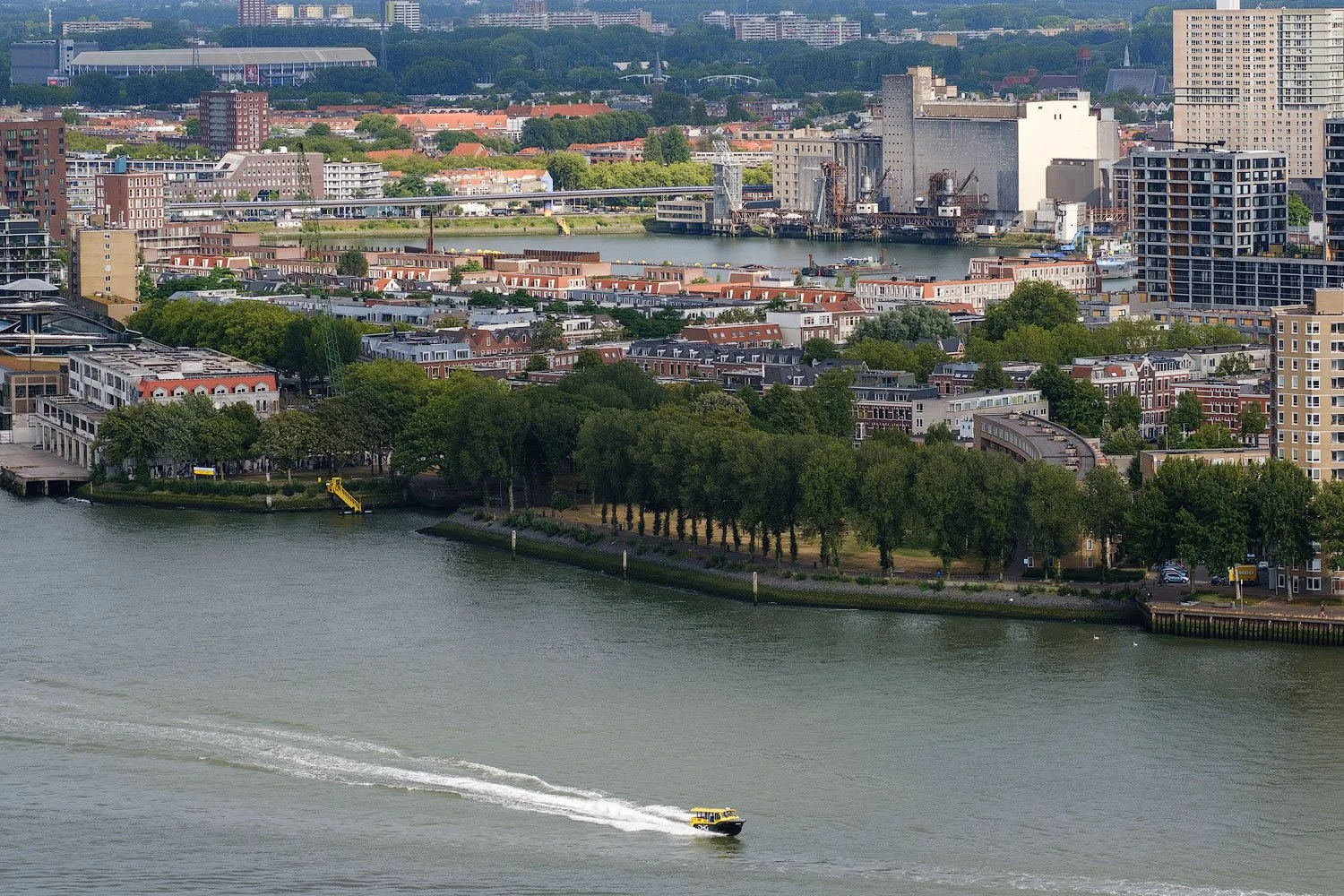
Fujifilm X‑T4 + Sigma 100-400mm // 100mm, f/8, 1/640 sec, ISO 320 (handheld)
The water taxi gave me a different handheld test.
Rotterdam’s water taxis are something else—quite different from the ones I am used to seeing in Venice. The boat was moving quickly and shaking enough to make precise framing difficult. I photographed at around 1/4000 second, with the lens stabilization switched on.
The combination worked very well. I came back with sharply defined photographs despite the movement. The stabilization was useful before the exposure too, because it settled the viewfinder enough for me to compose more precisely while the boat was moving.
I would not give the stabilization all the credit. At 1/4000 second, the shutter speed was doing a great deal of the work. This is how equipment is normally used in the field: several good decisions supporting one another rather than one feature producing the result by itself.
Fujifilm X‑T4 + Sigma 100-400mm // 100mm, f/5.6, 1/4000 sec, ISO 640 (photographed handheld from a moving water taxi)
Fujifilm X‑T4 + Sigma 100-400mm // 100mm, f/5.6, 1/3200 sec, ISO 640 (photographed handheld from a moving water taxi)
100% crop
Fujifilm X‑T4 + Sigma 100-400mm // 100mm, f/5.6, 1/4000 sec, ISO 640 (photographed handheld from a moving water taxi)
Sharpness at 400mm: when you are also photographing the air
Rotterdam also gave me one of the clearest examples of why a distant 100% crop needs to be interpreted carefully.
At 400mm, a 100% crop does not test only the lens. It also tests every metre of air between the camera and the subject.
I made two photographs of a distant IKEA sign at 400mm, one immediately after the other. The camera position, focal length and exposure remained effectively the same. Yet the fine edges of the letters and the structures around them did not look identical. They seemed to ripple and change shape between frames.
Frame 1
Frame 2
Atmospheric distortion comparison: 300% crop of two consecutive photographs of the same distant sign at 400mm. The changing shape of the fine edges reveals atmospheric distortion.
The optical performance of the lens had not changed within a fraction of a second. The air between the camera and the subject had.
At these focal lengths, we magnify more than the subject. We also magnify atmospheric turbulence. Warm surfaces, temperature differences and moving air can distort small details enough to look like poor focus or optical softness.
This does not explain every soft photograph. Focus can still be wrong, the shutter speed can be too slow, and camera movement can still reduce detail. What these two frames demonstrated is why a single distant image should not be used to judge the long end of the zoom. Across the complete set of photographs, the lens remained consistently sharp throughout its range; between consecutive distant frames, the air could still change how that detail appeared.
The useful clue is how the detail changes. Optical softness tends to appear in a similar way from one frame to the next. Atmospheric distortion moves. When the shape of fine details changes between consecutive photographs, the air has to be part of the diagnosis.
Autofocus, Stabilization & Field Handling on Fuji Bodies
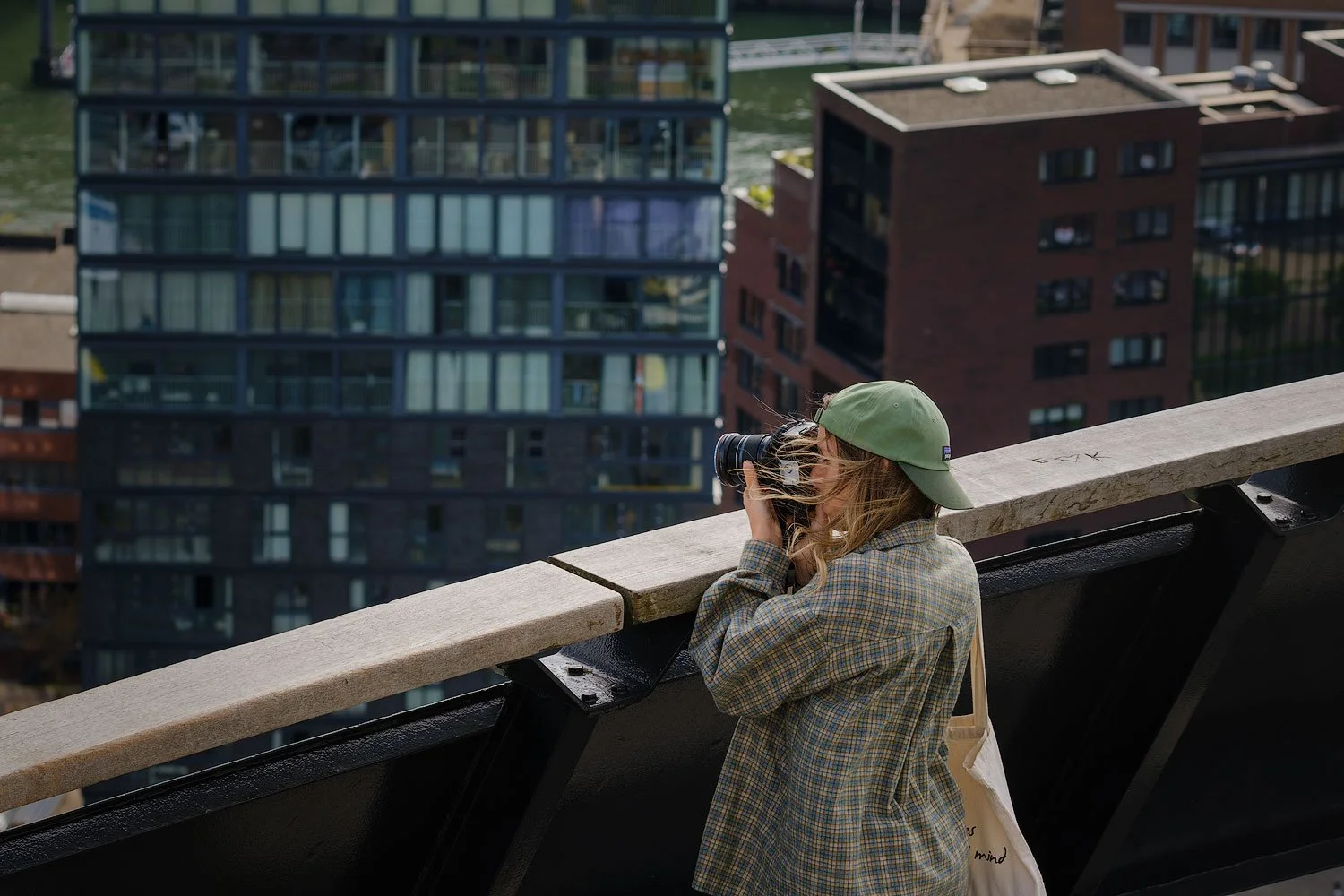
Using the lens in Iceland and Rotterdam made the practical strengths and weaknesses easier to separate.
Calling a 1,135g lens light would be generous. For a 100–400mm, however, the Sigma felt manageable. I carried it through Rotterdam without feeling that it was getting in the way, and I enjoyed using it handheld in both places.
Handheld ergonomics: Sigma 100–400mm F5–6.3 Contemporary extended on the Fujifilm X-T4.
Stabilization: the optical stabilization was one of its strongest features. In Iceland, it helped me work through strong wind. I often used a firm grip, a sufficiently fast shutter speed and continuous low-speed burst mode, then selected the sharpest frame made between gusts. In Rotterdam, stabilization made the viewfinder easier to control and supported the fast shutter speed I used on the water taxi.
Autofocus: it was quick, accurate and entirely suitable for the landscapes, architecture and slow-moving subjects I photographed. I also used AF-C occasionally for cars, with reliable results. I did not test the lens seriously for birds, wildlife or fast action, so this review should not be read as a complete assessment of those uses.
Autofocus needed more attention when haze or sand reduced contrast. I lost a few frames from stitched panoramas because focus shifted or missed—difficult conditions for any system, but a useful reminder to focus once and then lock it before beginning a telephoto panorama.
Build quality: it felt very good, and the zoom ring was smooth and precise. I did, however, prefer the physical layout of the Fujinon 100–400mm. The Sigma zoom ring sits farther forward and turns in the opposite direction. As the lens extends, my supporting hand moves forward too, which makes it harder to keep my elbow tucked in and hold the system as steadily.
Aperture ring: the lack of an aperture ring remained my most persistent irritation. Changing aperture from the camera body is easy enough, but after years of using Fujinon lenses, my hand naturally expects that control to be on the lens. In strong wind and sand, the difference felt more noticeable.
How much does the separately sold tripod collar really matter?
The Sigma can be fitted with the compatible TS-111 tripod collar. Given that the lens weighs more than a kilogram, I would have preferred the collar to be included rather than offered separately.
It cost approximately €128 when I checked in August 2026. Without it, mounting the camera body directly to a tripod makes the setup front-heavy and changing orientation more awkward. In Iceland, I missed having the collar on a couple of occasions.
At the same time, describing the lens as unusable without it would not match my experience either. Most of the photographs I made with it were handheld. In Rotterdam, where I carried a tripod throughout the assignment, it never left the bag.
Having to buy the collar separately matters if tripod work is central to how you photograph. If you mainly work handheld, that difference may matter far less in practice.
Sigma 100-400mm vs. Fuji 70-300mm & Fuji 100-400mm Comparison
For Fujifilm X photographers considering these three lenses, the decision is not only about image quality. I did not test the Sigma and Fujinon 100–400mm side by side, so this is not an optical shootout. My conclusion comes from the Sigma files, my previous experience with the Fujinon lenses and the practical differences between them.
| Specification | Sigma 100–400mm DG DN | Fujinon XF 70–300mm | Fujinon XF 100–400mm |
|---|---|---|---|
| 35mm Equivalent Range | 150–600mm | 105–450mm | 150–600mm |
| Maximum Aperture | f/5–6.3 | f/4–5.6 | f/4.5–5.6 |
| Weight | 1,135 g (2.5 lbs) | 580 g (1.28 lbs) | 1,375 g (3.03 lbs) |
| Filter Thread | 67 mm | 67 mm | 77 mm |
| Aperture Ring | No | Yes | Yes |
| Weather Sealing | Mount gasket only | Fujifilm WR construction | Fujifilm WR construction |
| Official Fujifilm teleconverter support | No | Yes (1.4x & 2x) | Yes (1.4x & 2x) |
| Approx. Price (August 2026) | ~€1,049 | ~€799 | ~€1,699 |
At standard European retail prices when I checked in August 2026 (approximately €1,049), the Sigma sits roughly €250 above the 70–300mm (€799) and €650 below the Fujinon 100–400mm (€1,699). Adding the optional TS-111 collar (~€130) brings the Sigma to around €1,179, narrowing the difference slightly without removing its considerable price advantage over the native 100–400mm.
That €650 difference is large enough to influence the rest of a camera kit or fund a dedicated scouting trip. It is a far more practical way to evaluate the Sigma’s position than simply calling it the “cheaper” option.
F6.3 can sound like a considerable compromise, especially for wildlife in low light. At 400mm, however, the difference from the Fujinon’s F5.6 is only around one third of a stop—not a full stop. For the landscape and city work I was doing, that mattered less than stabilization, shutter speed and the physical experience of using the lens.
The Fujinon 70–300mm makes the most sense if low weight and a more useful short end matter most. The Sigma is the strongest middle ground if you want 400mm without carrying the heavier Fujinon. The Fujinon 100–400mm suits photographers who place more value on native controls, more extensive sealing and having the tripod collar included for regular tripod use.
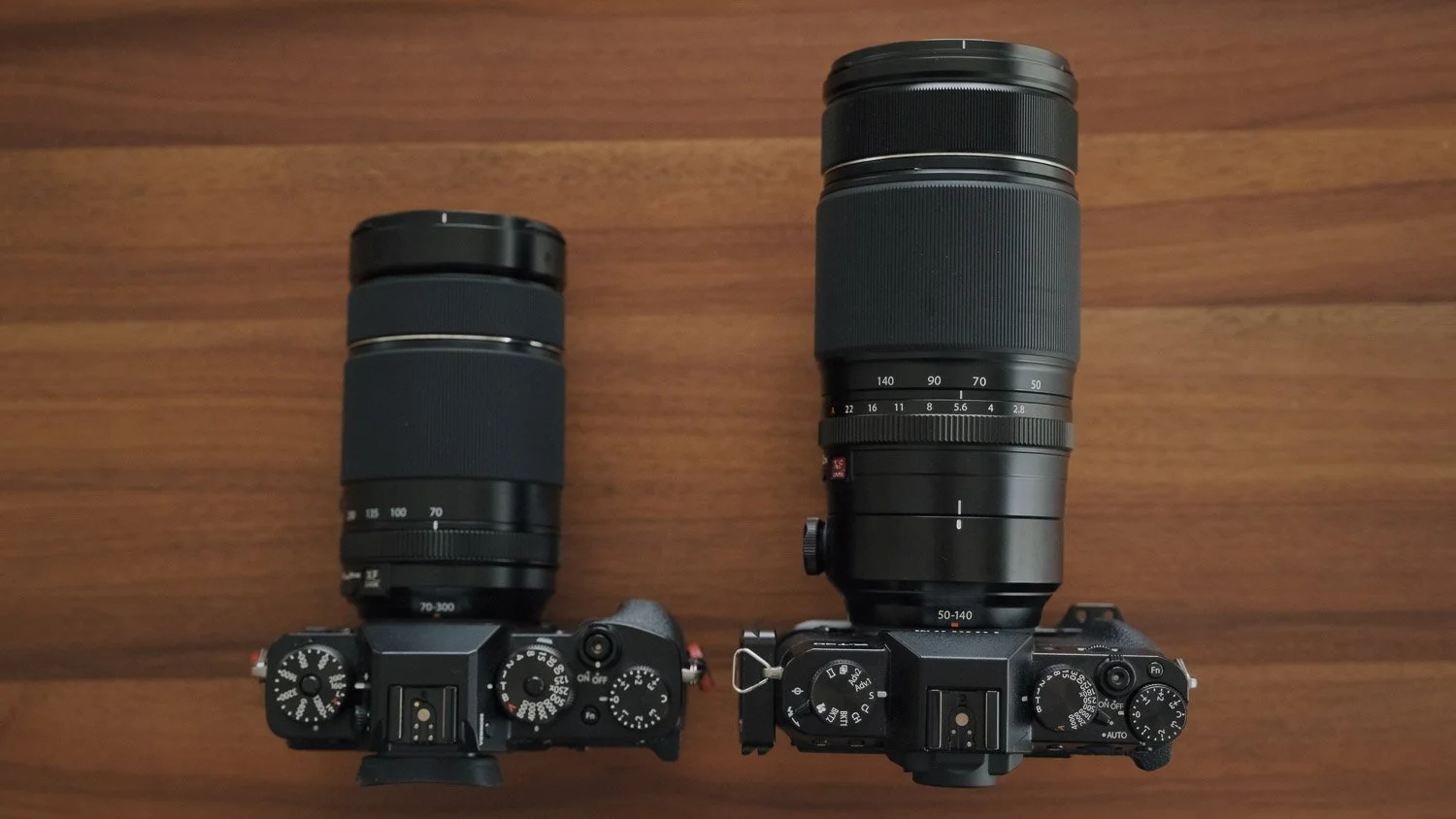
Fujinon XF70-300mm f/4-5.6 R LM OIS WR vs Fujinon XF50-140mm f/2.8 R LM OIS WR
For my own landscape work, I would probably choose the Fujinon 100–400mm. I prefer its aperture ring and control layout, and its tripod collar is already included. The Sigma also accepts the optional TS-111 collar, but adding it means a separate purchase and extra cost.
That preference is not based on disappointment with the Sigma’s image quality, which is absolutely great. The decision comes down mostly to the physical experience of using the lenses and what is included from the start.
Sigma 100–400mm for Fujifilm X: final verdict
After using the Sigma in both places, my conclusion is fairly simple. It is a specialist lens, but not a one-subject lens.
In Iceland, it helped me build tighter compositions inside a huge landscape. The longer focal range made me pay attention to small relationships that I could easily have missed with a wider view.
Rotterdam showed me something different. Used alongside the Sigma 10–18mm and Fujinon 50–140mm, the 100–400mm became another layer in the visual story of the city. It allowed me to isolate architecture, work with patterns and colour, photograph confidently from a moving boat and create views that went against the more obvious wide-angle approach.
It was not always the most convenient lens. The 100mm short end made the Euromast panorama more complicated, the missing aperture ring never felt completely natural to me, and for regular landscape work I would want to add the optional TS-111 tripod collar.
None of those points changes the quality of the photographs. The Sigma is well built, manageable for its range, consistently sharp from 100mm to 400mm and genuinely enjoyable to use. It makes the most sense for someone who wants extra reach, prefers to work handheld and enjoys building tight, deliberate compositions. It makes less sense as a single lens for general travel or for anyone who often needs to begin wider than 100mm.
That is perhaps the most useful distinction I can make: an excellent lens and the right lens are not always the same thing. The Sigma proved itself optically and creatively. My preference for the Fujinon comes from its controls and the convenience of having the tripod collar included, not from an assumption that a native lens will automatically make better photographs.
The Iceland video explains how the lens changed the way I approached a familiar landscape. This article adds the closer optical evidence and, through Rotterdam, a second answer to the same question: a long lens can do more than bring distant subjects closer. It can extend the way we describe a place.
Fujifilm X‑T4 + Sigma 100-400mm // 145mm, f/5.6, 1/320 sec, ISO 800 (handheld)
Fujifilm X‑T4 + Sigma 100-400mm // 400mm, f/6.3, 1/320 sec, ISO 800 (handheld)
Fujifilm X‑T4 + Sigma 100-400mm // 400mm, f/6.3, 1/500 sec, ISO 640 (handheld)
Fujifilm X‑T4 + Sigma 100-400mm // 135mm, f/8, 1/125 sec, ISO 320 (handheld)
Fujifilm X‑T4 + Sigma 100-400mm // 120mm, f/5.6, 1/400 sec, ISO 800 (handheld)
Fujifilm X‑T4 + Sigma 100-400mm // 400mm, f/6.3, 1/320 sec, ISO 800 (handheld)
Fujifilm X‑T4 + Sigma 100-400mm // 135mm, f/5.6, 1/320 sec, ISO 640 (handheld)
Fujifilm X‑T4 + Sigma 100-400mm // 100mm, f/5, 1/250 sec, ISO 1600 (handheld)
Fujifilm X‑T4 + Sigma 100-400mm // 100mm, f/5, 1/250 sec, ISO 5000 (handheld) - Noise reduction processed with DxO PureRAW 6
Sigma 100–400mm for Fujifilm X: common questions
What is a 100–400mm lens good for?
A 100–400mm lens is useful when you want to isolate distant subjects, simplify a busy scene or compress spatial relationships. In this review I used it for layered landscapes in the Icelandic Highlands, architectural details in Rotterdam and handheld photography from a moving water taxi. Wildlife and sports are also common uses for this focal range, but I did not test the Sigma seriously for either.
Is the Sigma 100–400mm good for wildlife?
On Fujifilm X, the 150–600mm-equivalent angle of view and five-stop optical stabilization make it well suited in principle to many wildlife situations. However, the maximum aperture is f/6.3 at 400mm, and I did not test its autofocus seriously on birds or fast-moving wildlife. I would therefore treat this article as evidence of its optical and handling performance, not as a complete wildlife autofocus test.
Should you buy a new Sigma 100–400mm or a used Fujinon XF 100–400mm?
If the prices are similar, the choice depends on which advantages matter most to you. A used Fujinon provides a physical aperture ring, more extensive weather sealing, an included tripod collar and official compatibility with Fujifilm’s teleconverters. Its condition, warranty and return options, however, will depend on the individual lens and seller.
The Sigma provides the reassurance of buying new, while remaining 240g lighter and using smaller 67mm filters. More importantly, its consistently strong image quality means that choosing it does not feel like accepting an optical compromise simply to save money.
For my own landscape work, the Fujinon’s controls and included tripod collar suit the way I photograph. Someone who values lower weight, buying new and primarily handheld use may reasonably reach the opposite conclusion and choose the Sigma.
Sigma 100–400mm or Fujinon 70–300mm with the 1.4× teleconverter?
The better choice depends on how often you genuinely need more than 300mm. With the 1.4× teleconverter attached, the Fujinon becomes a 98–420mm f/5.6–8. Remove it, and you return to a compact 580g lens that starts at 70mm and is particularly convenient for travel and long hikes.
The Sigma provides its complete 100–400mm range at f/5–6.3 without adding or removing a teleconverter. I would choose it if the 300–400mm range were an important and regular part of the photographs I planned to make. I would lean towards the Fujinon if I expected to work below 300mm most of the time and wanted the additional reach only occasionally.
I did not compare these combinations side by side, so I cannot draw a reliable conclusion about their relative image quality at approximately 400mm. The more useful distinction is between the Sigma’s direct access to 400mm and the Fujinon’s lighter, more modular approach.
How practical is the Sigma 100–400mm for hiking and travel?
At 1,135g, the Sigma is not a small travel lens, but its weight is reasonable for a stabilized 100–400mm zoom. It is also 240g lighter than the Fujinon 100–400mm, although 555g heavier than the much smaller Fujinon 70–300mm.
I carried and used it handheld throughout Iceland and Rotterdam without feeling that its size or weight outweighed its creative value. It makes the most sense when 400mm is a deliberate part of the photographs you want to make. For a general trip where that additional reach is less important, the smaller 70–300mm may be easier to justify carrying.
For photographers who specifically want 400mm, the Sigma offers a strong balance between reach, weight and handheld usability.
Can the Sigma 100–400mm use a Fujifilm teleconverter?
The Fujifilm X-mount version of the Sigma 100–400mm does not offer official teleconverter support. Sigma’s own 1.4× and 2× teleconverters are compatible with the L-mount version only, while Fujifilm does not list the Sigma among the lenses officially supported by its XF teleconverters.
Individual users have reported experimenting with the Fujifilm XF 1.4× teleconverter, but this does not make the combination officially compatible. I have not tested it myself, and its operation is not guaranteed by either manufacturer.
My own experience with Fujifilm teleconverters has been limited to briefly trying both the 2× and 1.4× with the Fujinon 50–140mm in Iceland. With the 2× attached, the lens becomes a 100–280mm f/5.6. The additional reach was considerable, but the resulting image quality fell noticeably below the level I would personally be happy to accept, particularly considering how good the 50–140mm is on its own.
At normal viewing size, the complete photograph still works visually, but the accompanying 100% crop makes the compromise easier to see. Based on this brief test, the loss of image quality was too significant for me to consider using the 2× teleconverter in my own photography.
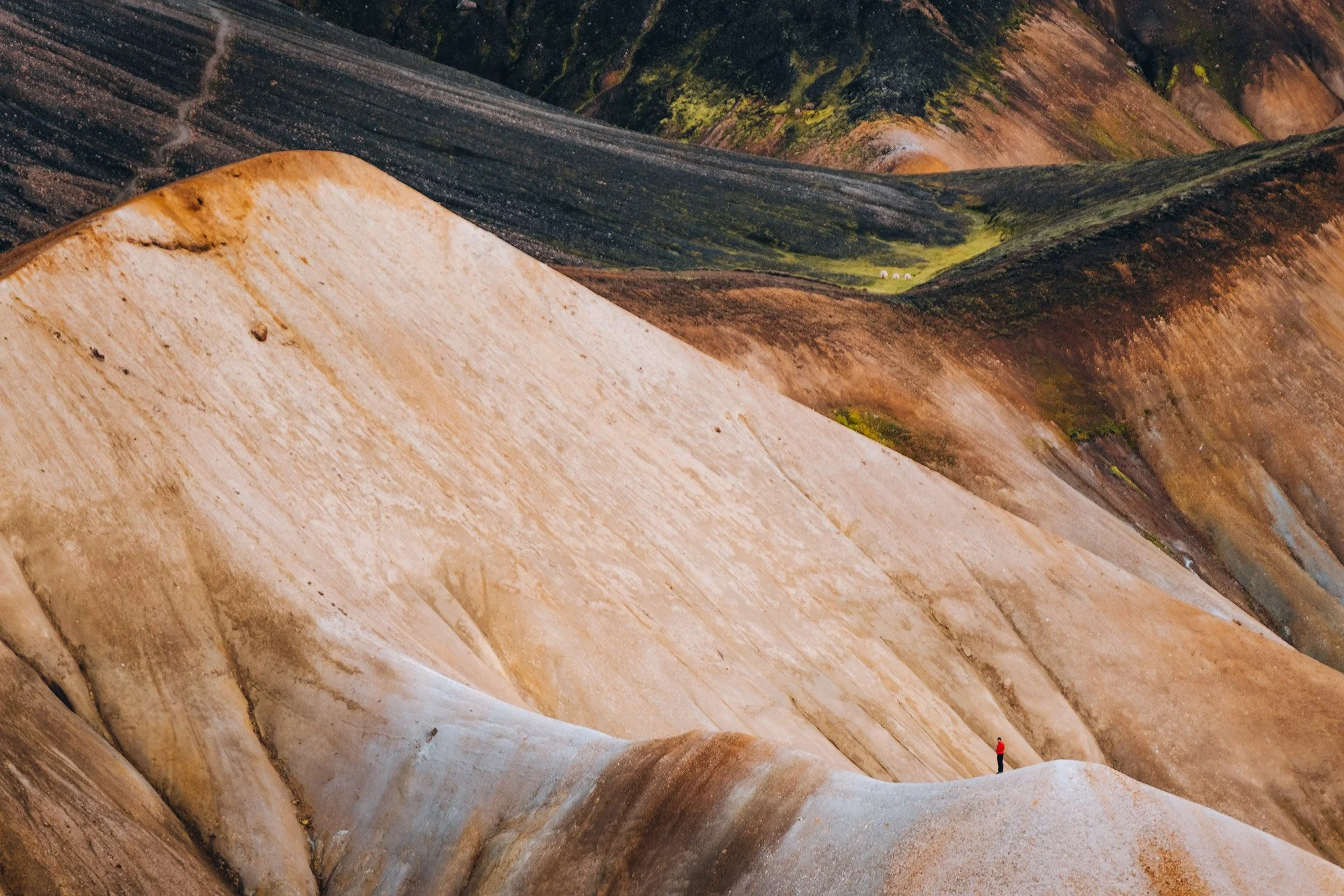
Fujinon 50–140mm f/2.8 with the XF 2× teleconverter. At normal viewing size, the layered rhyolite slopes and small figure still create a compelling photograph, although the complete image makes the loss of fine detail difficult to judge.
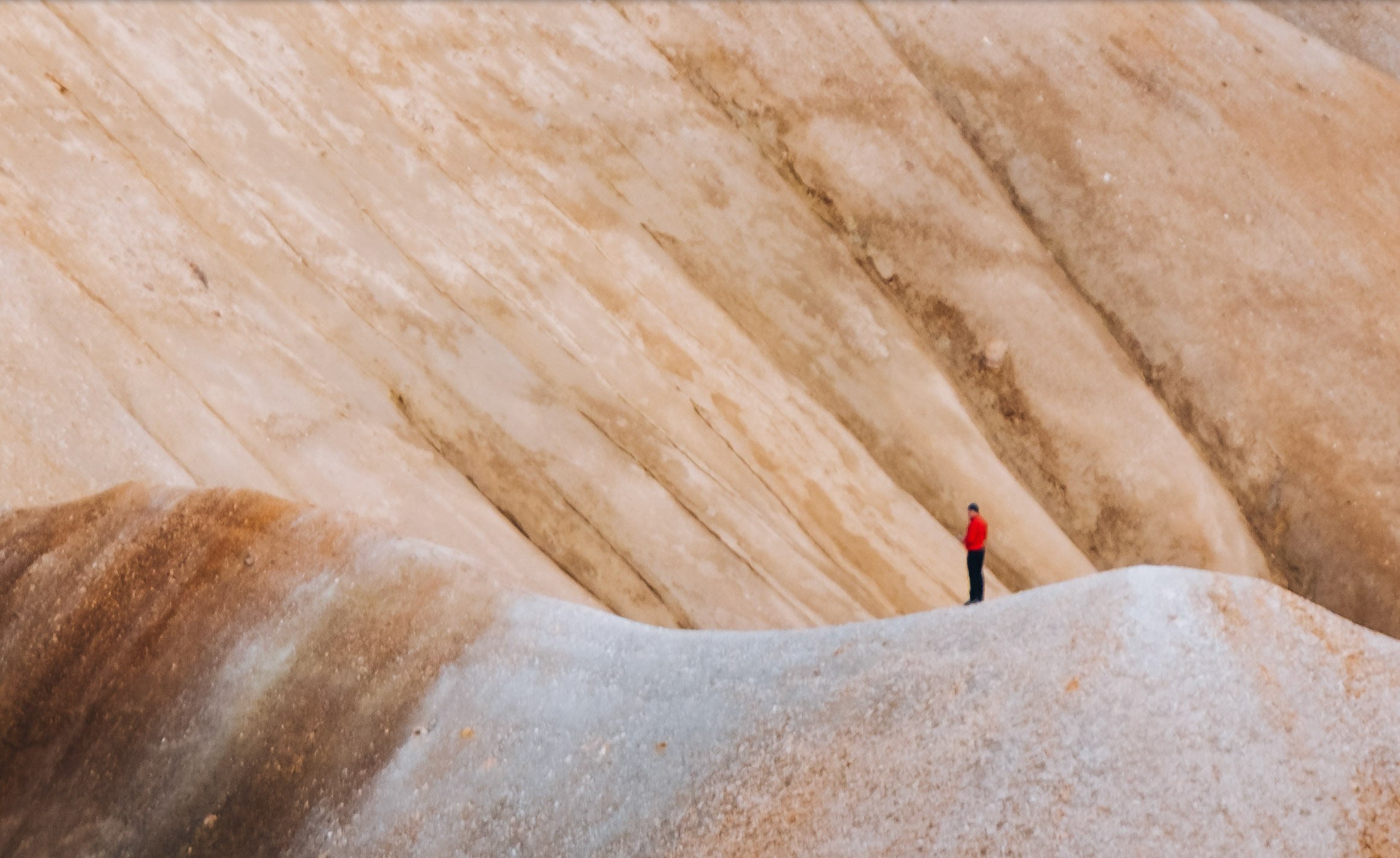
100% crop from the 2× teleconverter example. In this particular frame, the fine surface texture and edges around the figure are noticeably softer and less defined, which is why this brief test did not leave me confident in the resulting image quality.
My experience with the 1.4× teleconverter was considerably more positive. It turns the 50–140mm into a 70–196mm f/4, and both the complete photograph and its 100% crop show that the image quality remained very good. This is a combination I would feel much more confident using from a purely optical perspective.
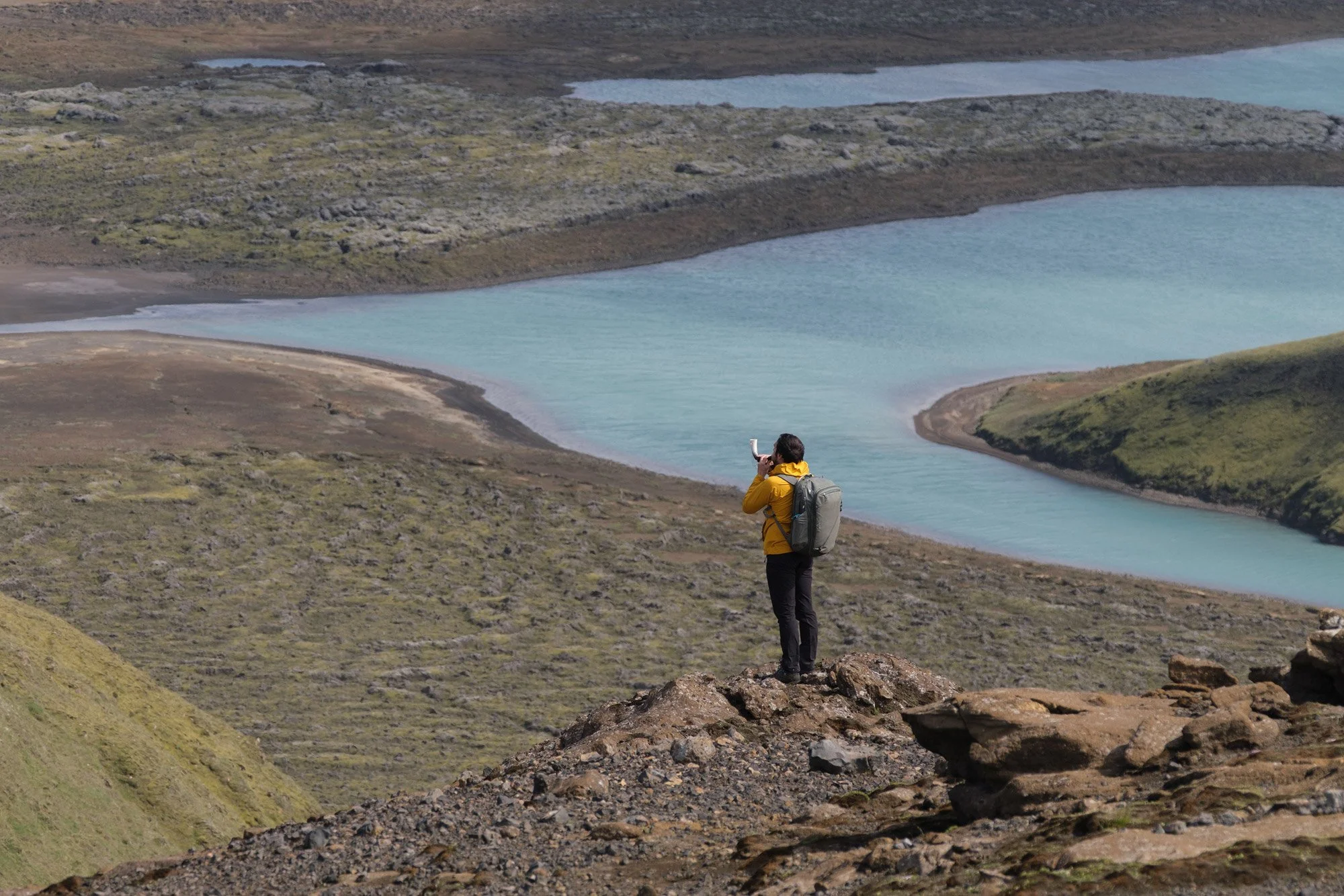
Fujinon 50–140mm f/2.8 with the XF 1.4× teleconverter. At normal viewing size, the photographer remains clearly defined against the turquoise water and rocky terrain, any loss of quality does not weaken the final photograph.
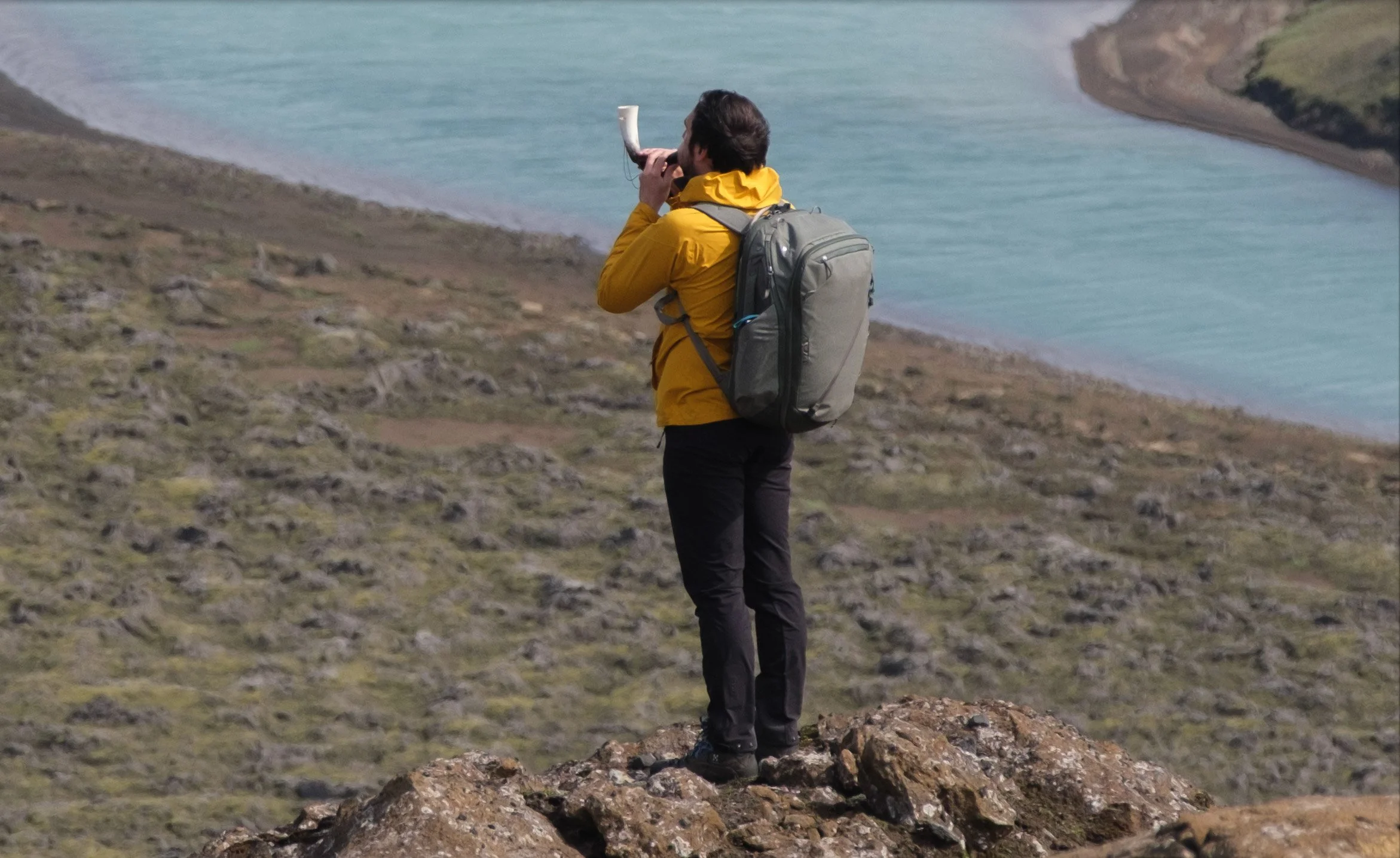
100% crop from the 1.4× teleconverter example. Details in the photographer’s clothing, backpack and the surrounding rocks hold together well, supporting my positive impression of the image quality produced by this combination.
Even then, the increase from 140mm to 196mm does not add enough reach to make the 1.4× particularly useful for the way I photograph. In most situations, the additional framing flexibility I need can be achieved by cropping in post-production, so I would rather keep the 50–140mm on its own.
These were practical field impressions rather than controlled laboratory comparisons, but they explain why teleconverter support is not a decisive factor in my own choice of lens. I would evaluate the Sigma primarily as a standalone 100–400mm lens on Fujifilm X.
Is f/6.3 too slow at 400mm?
For the landscape and city photography in this review, I did not find it limiting. At 400mm, the Sigma’s f/6.3 maximum aperture is only around one third of a stop slower than the Fujinon 100–400mm at f/5.6. In my use, the effective optical stabilization, an appropriate shutter speed and good handling technique mattered considerably more.
Photographing moving wildlife in very low light places different demands on any lens in this aperture range. Stabilization can reduce camera movement, but it cannot freeze a moving animal or bird, so a higher ISO may still be necessary. I did not test the Sigma seriously for fast wildlife or birds in flight, and I would prefer not to draw conclusions about a type of photography I did not properly assess.
Want to photograph the Icelandic Highlands with me?
You can watch my complete Sigma 100–400mm Iceland video for more footage from the Highlands and a closer look at how I used the lens in the field.
If you enjoy articles like this—where the equipment is only one part of the photographic decision—I share more thoughts on composition, working in the field and landscape photography in my weekly newsletter. You’ll also receive my free composition guide when you join.
And if photographing the Icelandic Highlands with me is specifically what interests you, you can explore the Iceland workshop and future editions here.

Eight days, four photographers, and a landscape that changed the plan every morning. Here's what actually happened on our 2026 Iceland Highlands workshop.